Sixth IOS Ibn Khaldun Lecture on the “Treatment of non-Muslims under the Muslim Dynasties of the Deccan”
Sixth IOS Ibn Khaldun Lecture on the “Treatment of non-Muslims under the Muslim Dynasties of the Deccan”
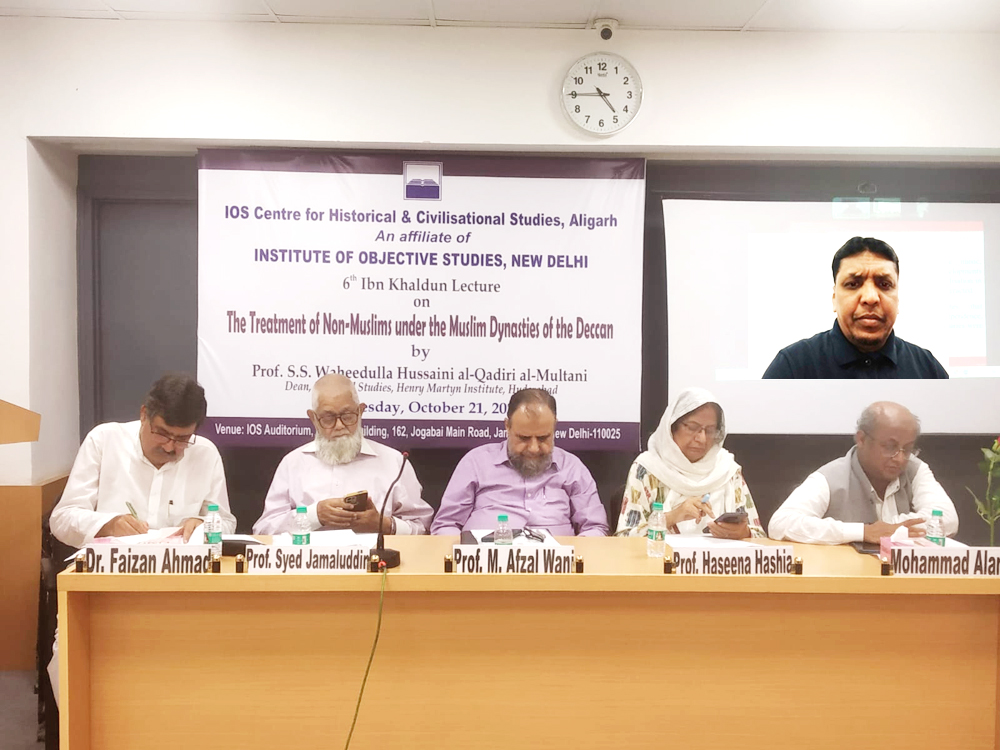
New Delhi: The sixth Ibn Khaldun lecture on the “Treatment of non-Muslims under the Muslim Dynasties of the Deccan” was organised by the IOS Centre for Historical and Civilisational Studies at the IOS auditorium on October 21, 2026 in the hybrid mode.
The programme began with the recitation of a verse from the Holy Qur’an by Mansoor Ahmad, in-charge of the IOS Computer Section, who also presented its Urdu translation. Prof. Syed Jamaluddin, Director of the IOS Centre for Historical and Civilisational Studies, Aligarh, presided over the programme. The lecture was delivered by Prof. S.S. Waheedulla Hussaini al-Qadiri al-Multani, Dean of Doctoral Studies, Henry Martyn Institute, Hyderabad.
Introducing the speaker and the subject, Prof. Haseena Hashia, Vice-Chairperson of the IOS, highlighted Prof. Hussaini's academic background and research on the grants extended by the seventh Nizam, Mir Osman Ali Khan, to religious personalities and institutions. She observed that the lecture would examine the political, social, economic, religious and cultural dimensions of relations between Muslim rulers and non-Muslim communities under the Bahmani, Nizam Shahi, Adil Shahi, Qutb Shahi, Barid Shahi, Imad Shahi and Asaf Jahi dynasties.
Delivering the lecture, Prof. Hussaini emphasised that the Deccan's composite culture had developed through interactions among Muslim traders, Sufis and local communities, facilitated by commerce, spiritual exchanges and the patronage of regional rulers, even before the establishment of Muslim political rule.
Discussing the Bahmani Sultanate (1347–1527), he said that its rulers retained established local administrative institutions and incorporated Hindu chiefs, landlords and officials into the governance system. Deshmukhs, Deshpandes, Patils and Kulkarnis continued to perform important functions in revenue collection, record-keeping and village administration. Local customs relating to marriage, inheritance and community affairs also continued in many areas.
Referring to Firishta's account, as interpreted by historian Haroon Khan Sherwani, he noted that some Bahmani rulers extended clemency to those who submitted, reinstated former officials and restored property. He also highlighted Firuz Shah Bahmani's cosmopolitan court and Ahmad Shah Wali's development of Bidar as an important political, scholarly and spiritual centre.
The speaker observed that the successor Sultanates largely continued this administrative tradition. Under the Nizam Shahis of Ahmadnagar (1490–1636), Hindu officials served in revenue administration, accounting, provincial governance and diplomacy. Malik Ambar relied on Maratha chiefs, Brahmin accountants and local officials to strengthen administration and improve land assessment.
The Imad Shahis of Berar (1490–1574), he said, also relied on local elites and inherited administrative structures. Similarly, the Adil Shahis of Bijapur (1490–1686) incorporated Hindu military commanders, administrators and intellectuals into their state institutions. Ibrahim Adil Shah II (1580–1627), through his Kitab-i-Nauras, exemplified the interaction of Persianate and indigenous cultural traditions.
Discussing the Qutb Shahis of Golconda (1490–1686), Prof. Hussaini highlighted their patronage of Persian, Telugu and Dakhni literature, music and architecture. Muhammad Quli Qutb Shah, who founded Hyderabad in 1591, fostered its development as a centre of administration and cultural activity. Hindu officials, including Madanna and Akkanna, held influential positions in the administration.
He also referred to the Bhadradri temple tradition associated with Bhakta Ramadas, a tahsildar under Abul Hasan Tana Shah. The episode illustrated the complex relationship between state authority and religious institutions. However, Prof. Hussaini cautioned that administrative accommodation and cultural interaction did not preclude instances of temple destruction and discrimination, particularly during military campaigns. Historical assessments, he stressed, must therefore consider individual rulers, regions and circumstances rather than rely on generalisations.
Turning to the Asaf Jahi state of Hyderabad (1724–1948), he described its administration as a continuation of the Deccan's tradition of cross-community participation. The career of Maharaja Kishan Prasad, who served twice as Prime Minister, illustrated the presence of non-Muslims in the highest offices of the state.
Drawing upon archival records, including muntakhabs, jaridas and administrative reports, Prof. Hussaini highlighted grants extended by the Nizams to Hindu temples, mathas, religious scholars and institutions. State patronage also covered religious festivals, the publication of Hindu scriptures, and the preservation of archaeological monuments and inscriptions in Sanskrit, Kannada and Telugu.
He further noted that Hindu merchants, bankers and trading communities contributed significantly to commerce, credit and revenue administration. Educational institutions such as Osmania University also brought together students from different religious backgrounds. These interactions, he argued, helped shape the distinctive composite culture of the Deccan.
Commenting on the lecture, archaeologist Faizan Ahmed, associated with the National Archives of India, said that non-Muslims had received considerable representation in the administration of the Deccan dynasties. He informed the audience that the National Archives preserved approximately 15,080 documents relating to the Deccan, including records from Hyderabad, Bijapur and Bidar. He also appreciated Prof. Hussaini's scholarly contributions and publications, including Anwar-i-Islam and Muslim Personal Law: A Guide.
In his remarks, Prof. M. Afzal Wani, Chairman of the IOS, called for greater research into the social and economic conditions of ordinary people under the Deccan dynasties, rather than concentrating exclusively on rulers and political events. He emphasised the importance of examining the role of Sufis in advising rulers and promoting justice, charity and peaceful coexistence. Referring to the Meesaq-e-Madina and contemporary international conventions, he urged scholars to undertake a comprehensive study of the historical instruments of peace and coexistence. He also encouraged greater investment in research and invited Prof. Hussaini to continue his association with the IOS.
Senior Urdu journalist Ahmad Javed observed that Sufis had played significant roles in several government departments under the Deccan rulers, with some also possessing knowledge of traditional medicine (Tibb). He contrasted this experience with the relatively different relationship between Sufis and rulers in North India.
In his presidential remarks, Prof. Syed Jamaluddin highlighted administrative continuity as a significant feature of Deccan history. He noted that Hindu functionaries continued to play important roles in revenue collection and local administration under successive Muslim dynasties. He also referred to Bidar's importance as a cultural and spiritual centre and highlighted the contribution of Deccan poets, particularly Wali Deccani and Qutb Quli Shah, to Urdu literature.
The programme concluded with a vote of thanks proposed by Mohammad Alam, Secretary-General of the IOS.
Go Back