IOS Organises Lecture on ‘Rising India’s Youth: Education, Accountability and the Question of Equality’
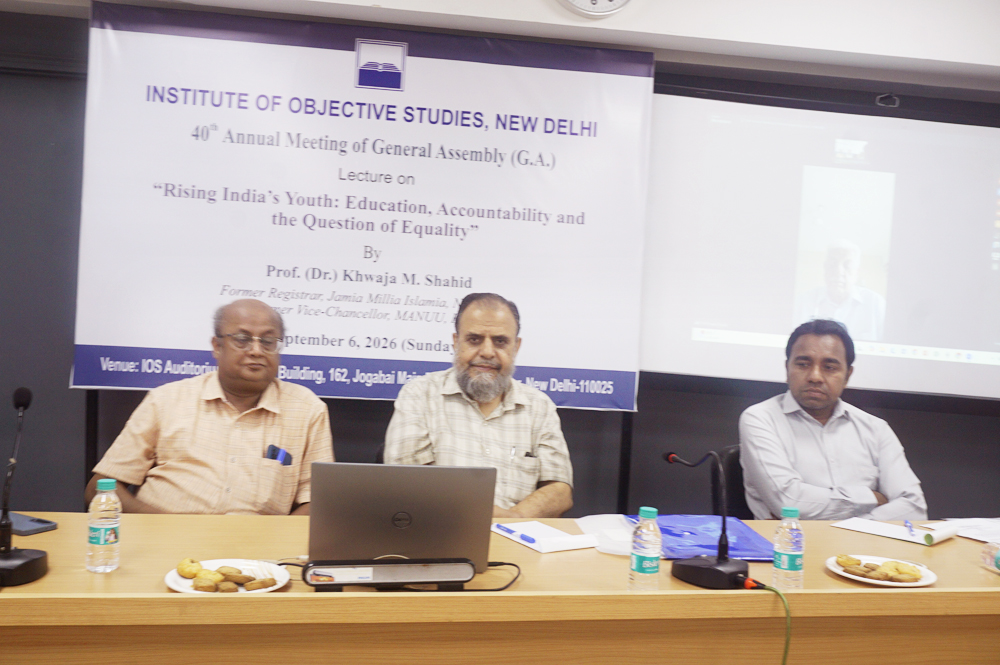
IOS Organises Lecture on ‘Rising India’s Youth: Education, Accountability and the Question of Equality’
New Delhi: The Institute of Objective Studies (IOS) organised a lecture on “Rising India’s Youth: Education, Accountability and the Question of Equality” on September 6, 2026, to coincide with the Institute’s 40th Annual Meeting of the General Assembly. The lecture was delivered by Prof. (Dr.) Khwaja M. Shahid, former Registrar of Jamia Millia Islamia and former Vice-Chancellor of Maulana Azad National Urdu University (MANUU), Hyderabad.
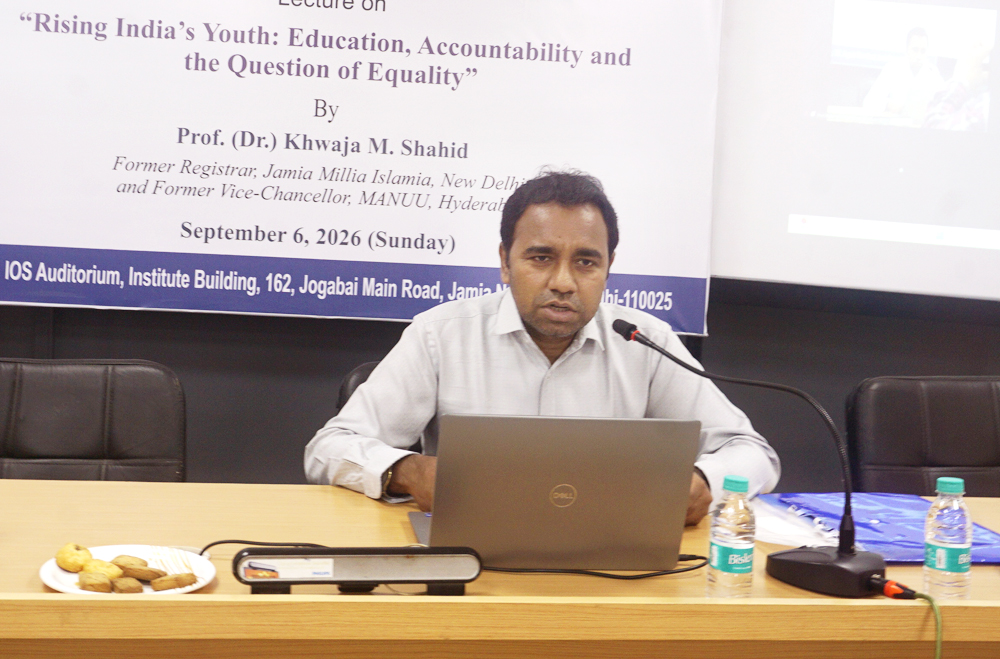
Introducing Prof. Shahid, Dr. Md. Aftab Alam, Associate Professor of Political Science at Zakir Husain Delhi College, University of Delhi, said that he was a former career civil servant, academic and administrator who had served as Vice-Chancellor of MANUU, Hyderabad, and Registrar of Jamia Millia Islamia, New Delhi. He noted that Prof. Shahid had played a significant role in the transformation of Jamia Millia Islamia from a deemed university into a full-fledged Central University. He had also served as a visiting expert to the University Grants Commission (UGC).
Dr. Alam further noted that Prof. Shahid joined the Central Secretariat Service in 1976 after qualifying through the Civil Services Examination. He served as Joint Secretary in the Union Public Service Commission (UPSC) Secretariat and was subsequently empanelled for the post of Joint Secretary to the Government of India. He was later appointed Director of the Institute of Secretariat Training and Management by the Ministry of Personnel, Public Grievances and Pensions. He has authored one book in English and three in Urdu.
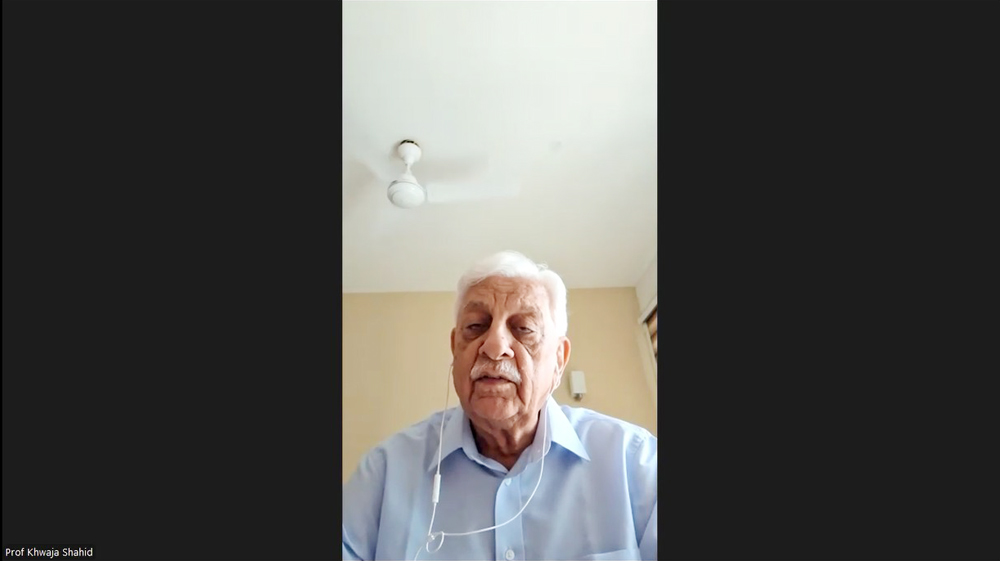
Delivering the lecture, Prof. Shahid paid rich tribute to the founder of the IOS, Dr. Mohammad Manzoor Alam. Describing the topic as highly relevant and contemporary, he referred to the agitation held at Jantar Mantar on July 20 and said that the concerns of young people extended far beyond protests. The anger of the youth, he observed, was a matter of serious concern.
Drawing on his experience as a professor and vice-chancellor, Prof. Shahid said that young people today were dynamic, active and energetic. If provided with adequate opportunities and a conducive environment, they could become a valuable asset to the nation. He called for addressing their social, economic, educational and religious concerns.
Education and employment, he said, were among the major challenges facing young people, while the sentiments of Generation Z (Gen Z) reflected their growing frustration. He emphasised that the education sector required greater attention. According to him, the growth in the number of colleges stood at 69.6 per cent, while student enrolment in colleges and universities remained inadequate. He also expressed concern over the declining number of schools, while noting that India continued to have the largest number of schools in the world.
He argued that the issue was not merely the number of schools but the need for a comprehensive overhaul of the school and higher education systems. Coaching institutions preparing students for admission to technical courses and the Union Public Service Commission examinations were another major area of concern. Citing a report published in the Economic and Political Weekly (EPW), he described coaching as one of the fastest-growing industries in India. He pointed to the proliferation of coaching centres in major cities such as Lucknow and Patna.
Curriculum Reform and Vocational Education
Prof. Shahid observed that the existing pedagogical system was not fulfilling its intended purpose. Intense competition, he said, was placing considerable stress on students.
“Our education syllabus was not in conformity with the requirements of employment. Vocationalisation of education should form a part of the curriculum. People in the government may differ with me, but I gathered this because I have been a member of several government bodies,” he said.
He suggested that specialised institutions, on the lines of the Indian Institutes of Technology (IITs), should be established to provide skill-development education. He stressed the urgent need to integrate vocational training into the education system and address the mismatch between academic qualifications and labour-market requirements.
While expressing satisfaction with the reported decline in unemployment, he noted that unemployment remained a particular concern among women and male graduates from rural backgrounds. He also expressed concern that students were increasingly attending coaching centres instead of relying on regular schooling, with schools often being reduced to places for examination preparation.
The growing use of artificial intelligence (AI) and generative AI tools such as ChatGPT, he said, was placing additional pressure on education and examination systems. AI required substantial infrastructure but could also support learning and provide information about labour-market trends. Recalling a conversation with a teacher, he said that students were using AI to check their answers, illustrating the changes taking place in the education system.
Discussing the impact of AI on employment, Prof. Shahid said that its use in the manufacturing sector was still limited, while the corporate world was increasingly being affected by technological developments. He referred to its growing applications in printing and medicine and noted its potential usefulness in agriculture and as a personal assistant.
However, he cautioned that AI was likely to affect young people and their employment prospects in the near future. Rural areas, he observed, lagged behind in the adoption of AI because of inadequate internet access. Employment and technology, he emphasised, were closely interconnected.
Reflecting on the role of young people in social and political movements, Prof. Shahid recalled Mahatma Gandhi’s call in 1920 for the youth to join the freedom movement, which was answered by thousands of students. He also referred to the opposition to the Emergency, when student leaders, including those associated with Patna University, protested against the suspension of fundamental rights guaranteed by the Constitution.
He cited youth-led movements in South Africa and the United States, referring to Martin Luther King Jr.’s struggle for civil rights and social justice. Similarly, he said, Gen Z had begun protesting against perceived injustices affecting young people, including the controversy surrounding the alleged leakage of the National Eligibility-cum-Entrance Test (NEET) question paper.
He described the protests as an effort to question governance and said that they had spread to other parts of the country. Patna, too, had witnessed protests over social issues, corruption and authoritarianism. These were among the concerns troubling young people, he said, but the question of government accountability remained insufficiently addressed.
Prof. Shahid identified accountability as one of the most important issues in governance. He said that university vice-chancellors, among other public authorities, had responsibilities towards young people. The rising assertion of the youth had brought questions of accountability to the forefront, as young people increasingly sought answers from the government on issues affecting their lives.
To illustrate the importance of accountability, he cited the case of a district magistrate in Noida who, according to his account, had been directed by the Allahabad High Court to pay ₹5 lakh from her personal funds as compensation to a woman who had been illegally detained under the National Security Act (NSA).
Quoting former President of India Dr. S. Radhakrishnan, Prof. Shahid emphasised that education should impart information, shape attitudes and develop a democratic outlook to help produce responsible citizens. He also referred to Mahatma Gandhi’s emphasis on the harmonious development of the body, mind and soul.
He stressed that students should be encouraged to imbibe moral values and apply them in their lives. Referring to the example of the Prophet Muhammad (peace be upon him), he advocated the promotion of a value-based society and called on Muslim minority educational institutions to give greater attention to moral education.
Speaking about the educational status of Muslims, Prof. Shahid observed that the community lagged behind on several indicators. He called on community leaders to develop a concrete plan to address these educational disadvantages.
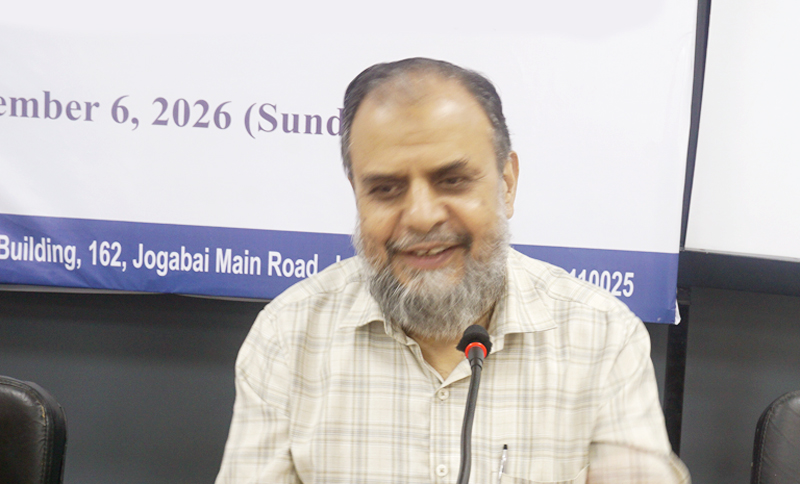
In his presidential remarks, IOS Chairman Prof. M. Afzal Wani observed that India was witnessing new experiments in education and that the process of change was continuing. He said that some of the changes had followed a change in the education minister, suggesting that adequate consultations on education had not taken place.
Referring to private schools and colleges, Prof. Wani noted that private educational institutions had existed since the 1950s and cautioned against rejecting them outright. While acknowledging concerns about the private sector, he pointed out that several private colleges, including St. Stephen’s College, Delhi, had established strong academic reputations.
He called for an effective regulatory mechanism to monitor educational standards and ensure quality. He also announced that the Institute would organise a series of lectures in the near future to facilitate a comprehensive understanding of the subject.
Reflecting on the aspirations of the younger generation, Prof. Wani said that young people wanted security, social support and greater autonomy. Their mental well-being needed to be protected, and they should be supported in overcoming mental-health challenges. He also emphasised the importance of ethical values and the wisdom of elders.
“Since the country is ours, there should be fellow feeling among us,” he said, stressing the need to promote social harmony and stability.
He further called for the establishment of adequate maternity homes to ensure proper care for children. Emphasising the importance of early childhood development, he said that every child should receive foundational education up to the age of eight to support intellectual and moral development. Skill development should follow at the appropriate stage, he added.
Prof. Wani also called for greater stakeholder participation in the management and improvement of private schools.
The lecture was attended in hybrid mode by members of the IOS General Assembly from across the country, as well as academics, scholars and students.
The programme concluded with a vote of thanks by Dr. Aftab Alam.
A view of audience
Go Back