IOS Lecture on “Modern Muslim Theology and Science”
IOS Lecture on “Modern Muslim Theology and Science”
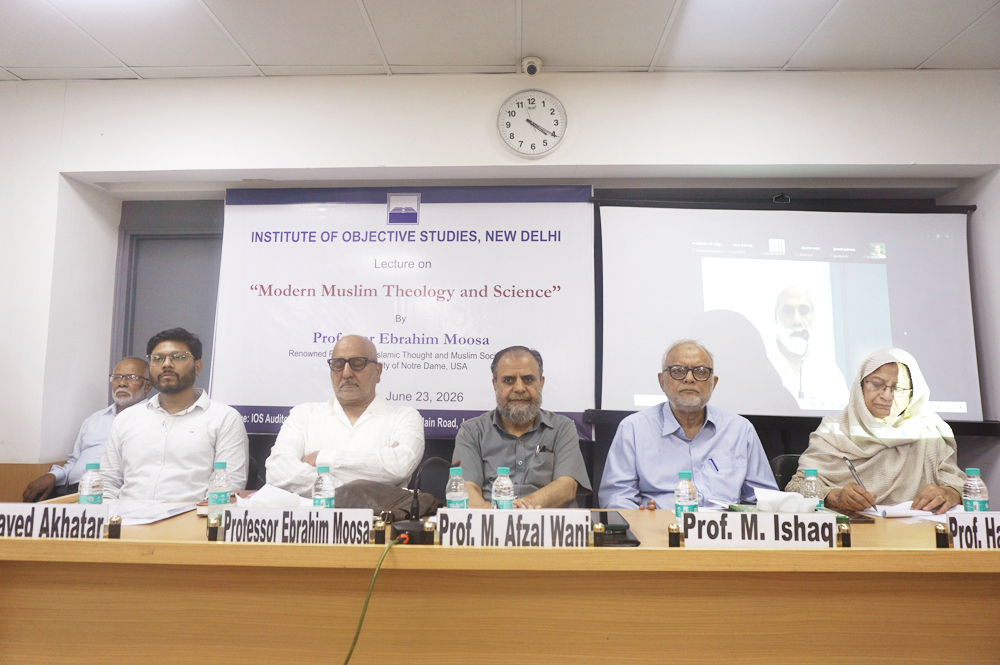
New Delhi: A lecture on “Modern Muslim Theology and Science” was organised by the Institute of Objective Studies here on June 23, 2026. The lecture was delivered by Prof. Ebrahim Moosa, a renowned professor of Islamic Thought and Muslim Societies at the University of Notre Dame, USA, where he teaches Islamic history and ethics. He also co-directs the Contending Modernities’ programme, and leads Madrasa Discourses, an initiative that promotes engagement between Islamic scholarship and the humanities, social sciences and sciences.
The lecture began with the recitation of a Qur’anic verse by Mr. Naseem Ahsan from the Arabic section of the Institute, with its translation in Urdu.
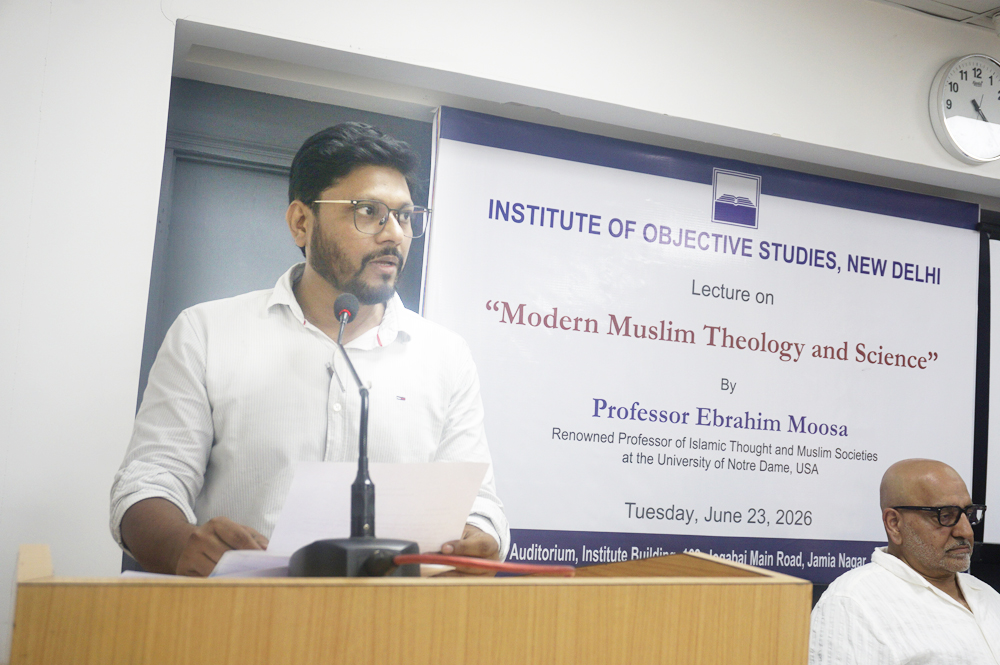
Welcoming the gathering at the lecture, Dr. Javed Akhtar, assistant professor of Islamic Studies at Jamia Millia Islamia, Nw Delhi, introduced the speaker. He said that Prof. Moosa taught at Duke University and the University of Cape Town, and was a visiting scholar at Stanford University. His research focuses on Islamic thought, ethics, education and modernity. He is the author of What is a Madrasa? An Introduction to Madrasas in India and Pakistan, and Ghazali and the Poetics of Imagination, and has edited numerous important works on Islamic reform and thought. Born in South Africa, he holds traditional Islamic training from Darul Uloom Nadwatul Ulema, Lucknow, India as well as advanced degree from the University of Cape Town. He is a frequent commentator on global Islamic affairs and has advised governments, international magazines and foundations on issues of religion, ethics, education and human rights.
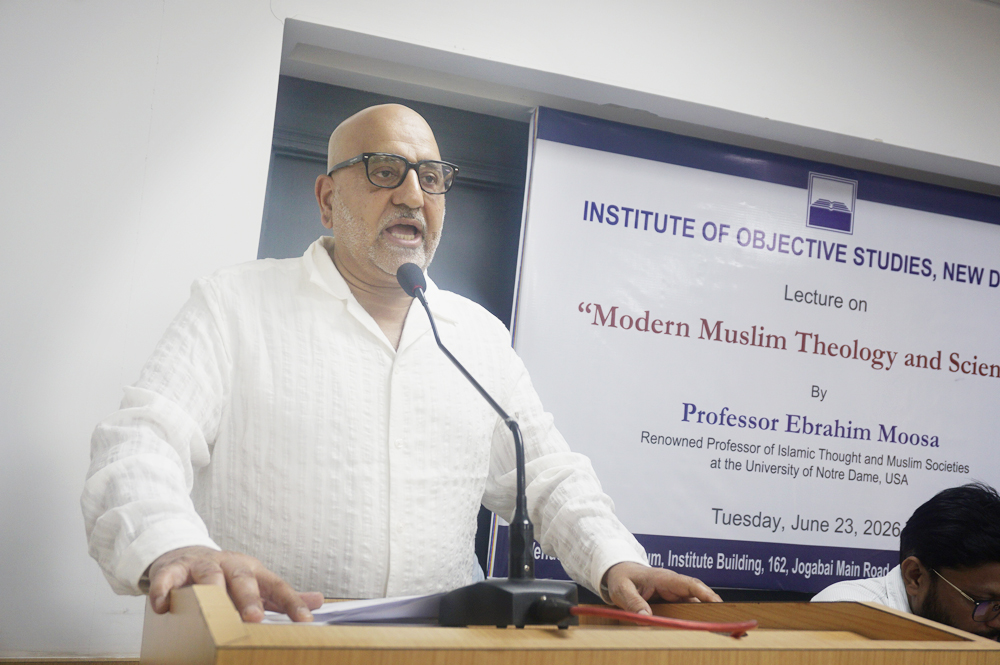
Delivering the lecture, Prof. Moosa held that Muslim theological encounter with science was a complicated issue. He referred to the scapegoat historiography and said that the pre-modern tradition was far more philosophically sophisticated — and far more comfortable with science than the decline story admits. He quoted Ghazali who said, “Whoever tried to dispute such theories, thinking it is their religious duty to do so, actually harms religion instead”. Replying to the question why modern Muslim theology struggles with science, he said that there were three over-lapping causes, but they could not be called a failure of Islam itself. One was colonialism under which science arrived wrapped in an imperial project. Accepting that it felt like cultural surrender, European knowledge was met with suspicion calcified into rejection. The second was scripturalism. Due to this, complex theology gave way to direct Qur’anic reading. The scripture was recast as a fact book containing answers to every question. And the third was that there were outdated models. “Theological framework built on pre-Copernican Cosmology cannot address the Big Bang, evolution, or artificial intelligence. The paradigm needs updating, not defending”.
Prof. Moosa said, “We must expose young ulema to science and cosmology. Each knowledge of theology is inter-connected. He noted that there were four responses to a single pressure. They were scholars confronting modern science in colonial South Asia and the Ottoman World. The bridge-builder was Muhammad Zakaullah who was a major figure supporting Sir Syed Ahmad Khan. According to him secular and Islamic knowledge are not different. He read modern science in English and sought genuine concord between Islamic tradition and the new cosmology. He was marginalized for being too curious. The careful theologian, Husayn al-Jiser said evolution requires not literal Qur’anic interpretation if proven - then quietly added. “I personally think this will prove impossible. Ambiguity was used as strategy. He held that according to Anwar Shah Kashmiri, the Qur’an speaks to human experience of nature, not to its scientific mechanics. The sky is described as a canopy—how it appears to people, not a cosmological claim. Kashmiri’s Hermeneutical key was the most philosophically sophisticated response in the tradition.
Referring to the phenomenal experience of the world, Prof. Moosa said the Qur’an speaks to us about human experience of nature. The sky looked like a protective canopy. The sun appeared to rise and set. It is a human experience. That is what Qur’an addresses—revelation speaking to ordinary people in the language of their experience. It was not astrophysics and not a scientific claim. Speaking about Maulana Ashraf Ali Thanvi’s contradiction, he observed that it was an epistemological framework applied selectively. He built a rigorous three-part epistemology – then bypassed it. He used a Qur’anic Verse to assert that sky is physical, skipping the empirical investigation of his own method. According to Nafs al-Amir, the thing as it is actually – scientific reality. He says the sky is not a physical vault. The earth orbits the sun. Anwar Shah Kashmiri deferred to scientific specialists on how things actually function. The Qur’an is not making empirical claims. It speaks to experience, not mechanics. He noted that Thanvi’s contradiction was a rigorous epistemological framework applied selectively. Qur’an is not astrophysics or science. But the conflict is psychological. He said that Maulana Abdul Bari Firangimahli wanted to write a six-volume book on theology and science. He described the modern Islamic thoughts as a ‘quick-fix’ to have ready-made answers.
Prof. Moosa held that the entire framework was symphonic and braided. It was neither a forced merger, nor the permanent separation braided—co-existence. Referring to science, he said that it investigated matter, energy, time and space. Besides, it went into origins, evolution, consciousness and cosmos. It spoke its own language and answered through evidence, experiment and mathematics. Theology addresses meaning, purpose and value. It also speaks of god, prophecy, revelation and salvation. It answers through interpretation, tradition and faith. He answered the question what a contemporary Muslim theology demanded. He said that the tradition held a vote—not veto. He laid stress on humanity and added that ancient consensus on secondary questions could be revisited. Secondly, there should be scientific common sense among theologians who could not think with the Big Bang and evolution work from medieval anatomy. Then, there should be imagination (Takhyil). Under this, resources for figurative, layered and non-literal reading that already existed, should be activated. He laid emphasis on aesthetic sensitivity. He said that scientific discovery revealed beauty. Theology could celebrate what the cosmos disclosed. Ambiguity was not a problem to eliminate. It was the invitation to deeper inquiry, he concluded.
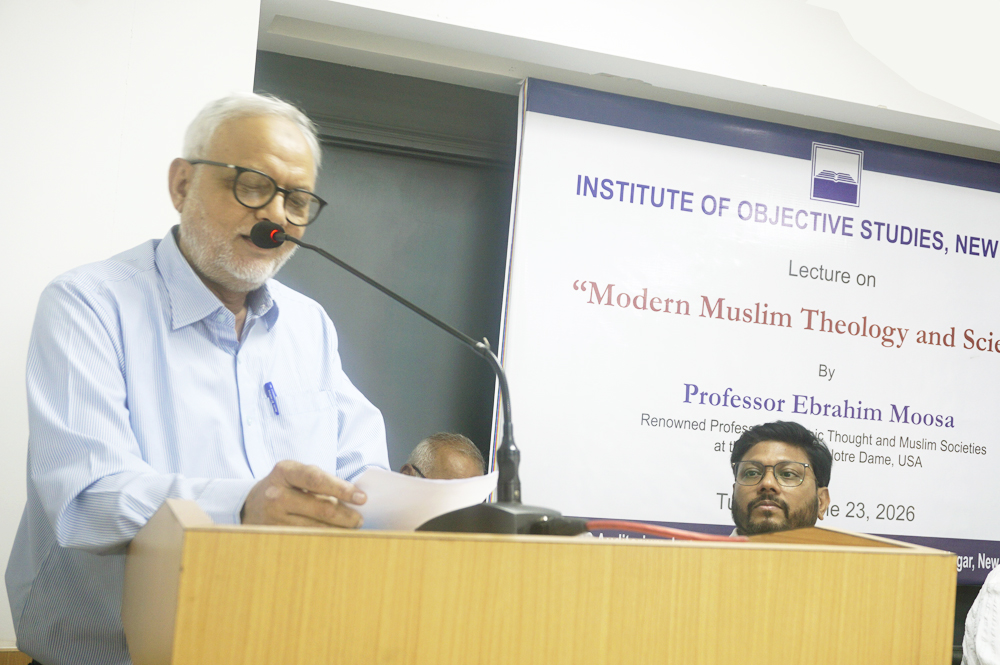
Former professor of Islamic studies and dean, faculty of humanities and langugages, Jamia Millia Islamia, New Delhi, Prof. Mohammad Ishaque, commented that the lecture on scientific and theological issues was very beneficial for researchers. He said that the knowledge of the western scholars about Islam was shallow and superficial. He noted that Prof. Moosa compared the classical Islamic thought with the modern thinking. Science and theology remained distant but remained inter-connected. Muslim scholars made significant contributions to the contemporary Islamic thought, he added.
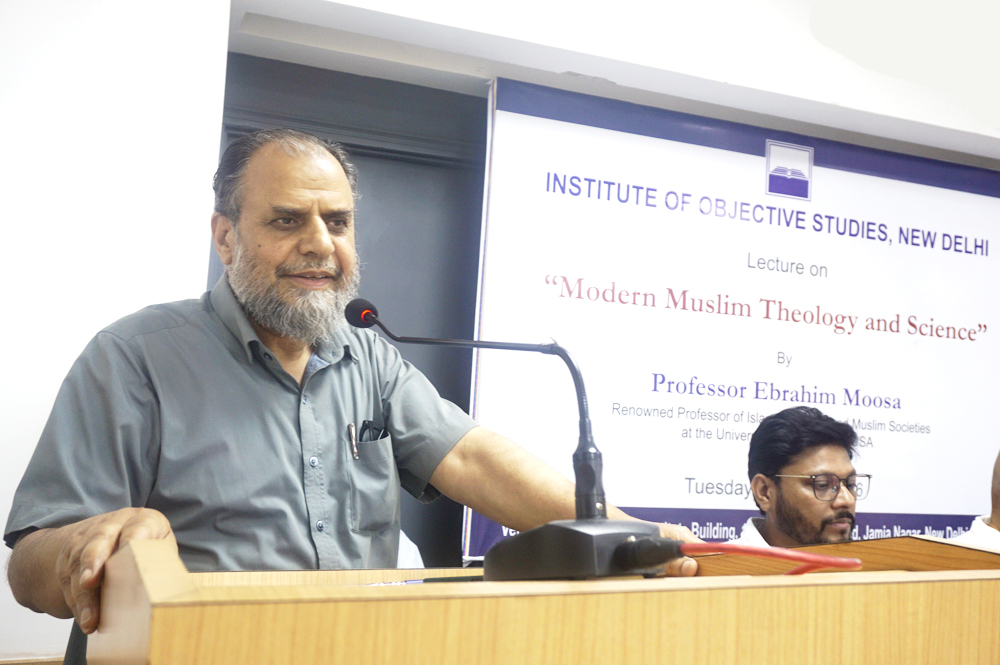
In his concluding remarks, the chairman of the Institute of Objective Studies, Prof. M. Afzal Wani said “We can pursue knowledge as much as Allah wants us to know”. Only the Prophet (peace and blessings be upon him) had the complete understanding of the Qur’an. We can forge ahead by following the teachings of the Qur’an. We pursue knowledge by viewing in a compartmentalized manner”. Referring to Imam Ghazali, he said that according to him, cleaning hands before eating food, could lead to one’s salvation. He opined that cleaning hands before consuming food reduced intense passion. Theories kept on changing, but the people became argumentative. “We work on hypothesis”. He prayed to Allah for showing the righteous path. By the grace of Allah, the second caliph of Islam, Hazrat Umar (R.A.) had an App, hundreds of years ago. He observed that the Magnum Opus of thoughts which Europe collected in a 400-year period, finally collapsed. He noted that knowledge gave humility. He asked the Muslims to take forward their business with innovations. He reiterated that the Institute would continue to bring forth the facts of all the religions”. We shall show the right path to the people with humility, he pointed out.
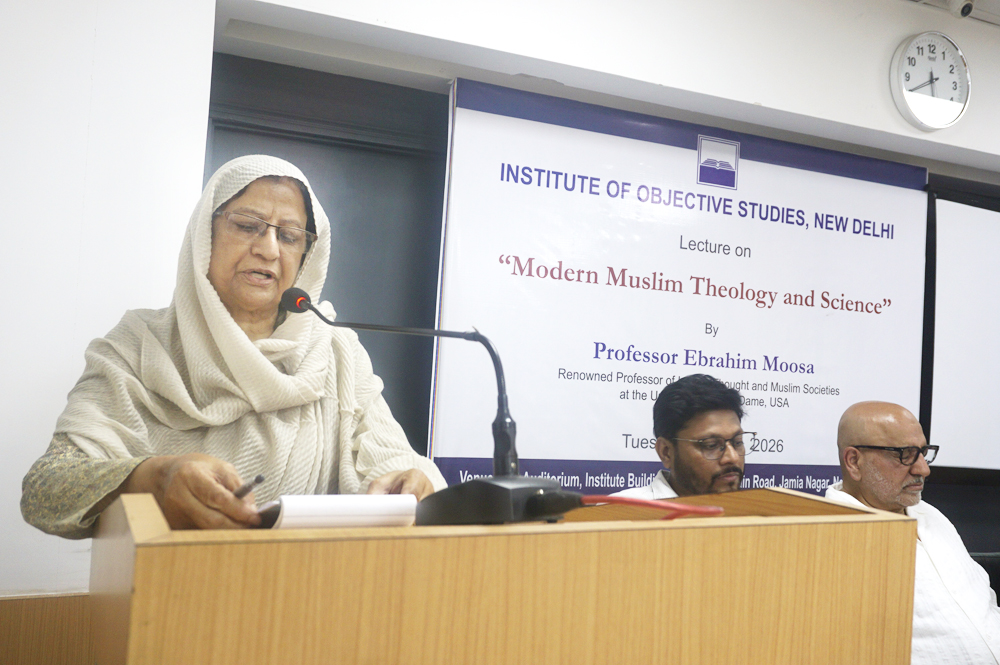
At the end of the lecture, vice-chairperson of the Institute, Prof. Haseena Hashia, extended a vote of thanks to the attendees. The programme was attended by a large gathering of academics, teachers and students from the department of Islamic Studies of Jamia Hamdard, and Jamia Millia Islamia, New Delhi.
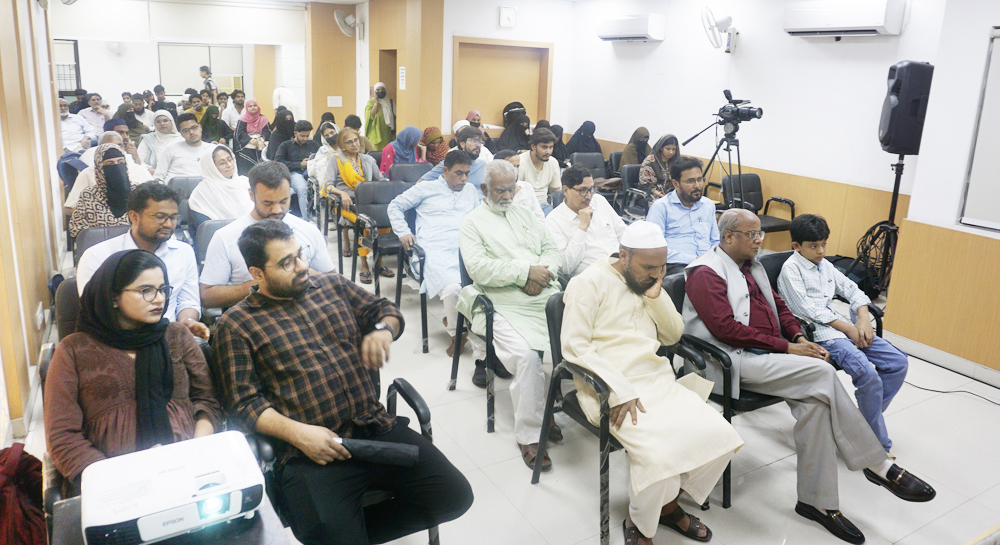
A view of audience
Go Back