IOS Lecture on ‘Perspectives on the Iran-US Showdown and its Regional Implications’
IOS Lecture on ‘Perspectives on the Iran-US Showdown and its Regional Implications’
New Delhi: A special lecture on ‘Perspectives on the Iran-US Showdown and its Regional Implications’ was organised by the Institute of Objective Studies here on February 14, 2026.
The lecture began with the recitation of a Qur’anic verse by the in-charge of the Multimedia section of the Institute, Mr. Mansoor Ahmad.
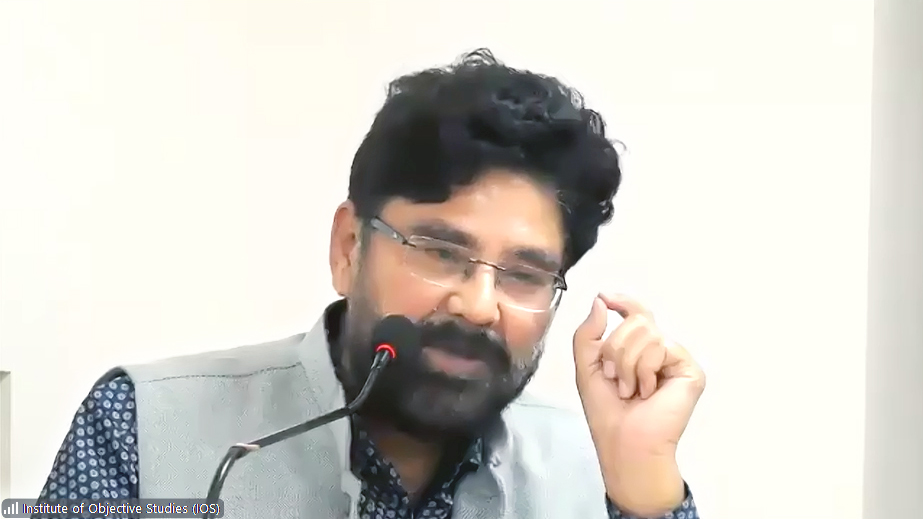
Prof. Mohammad Sohrab, a faculty member at the MMAJ Academy of International Studies, Jamia Millia Islamia, New Delhi, delivered the lecture. Prof. Sohrab specialises in West Asian studies, international politics, identity politics, multiculturalism, and Muslim world affairs. The objective of the lecture was to demystify the enigma surrounding Iran–US relations over the decades. There are divergent and even clashing perspectives on the looming spectre of a showdown between Iran and the US, with the potential to act as a regional and global vortex, generating seismic shocks with far-reaching consequences.
The proceedings of the lecture were conducted by the vice-chairperson of the Institute, Prof. Haseena Hashia, who introduced the speaker.
Making initial remarks, the chairman of the IOS, Prof. M. Afzal Wani, observed that the world was in conflict, especially politically. Conflicts among tribal communities and common people also existed. These were exacerbated by business interests. That is why the production of weaponry has not diminished, and armouries continue to receive a regular supply of arms. The conflict between the United States and Iran can be seen in this context. The confrontation between the two countries is not new. It began with the exit of Mohammad Reza Shah Pahlavi as the last monarch of Iran. He belonged to the Pahlavi dynasty that ruled the country for decades. After his exit following a revolution spearheaded by clerics, the Islamic Republic of Iran came into being. He said that after the establishment of the Islamic Republic, America felt that its interests in Iran would be compromised by the new regime. This became the main cause of conflict between the two countries. He expressed hope that the lecture would help students understand international relations and the Constitution, and how areas of conflict affect them.
Speaking on the subject, Prof. Mohammad Sohrab observed that the showdown between Iran and the US was looming large over the region. This shadow of conflict was not confined to the two countries. It was not merely bilateral but triangular, with historical precedents. Iran has faced attacks over the last 300 years and has often been a playground for major powers. There has been a constant struggle against domination. He said that before and after the World War II, America entered the region using terms such as equality, liberty, and justice. It may be noted that Iran had been strongly opposed to British suzerainty and subjugation by Czarist Russia. Later, however, Iran developed close ties with the US, and the lifestyle of its people changed, marked by Western influence. During this period, the Pahlavi dynasty ruled the country.
Later, Iran redefined Islamic and economic nationalism and nationalised the Anglo-Iranian Oil Company, which had functioned almost as a state within a state and was owned by Britain. This decision antagonised the US.
Prof. Sohrab held that the monarchy in Iran was supported by US economically and technologically. Iranian society was westernised and modernised, but lacked spirituality. Most common-use goods were imported from France. However, the Islamic Revolution of 1979 changed the situation, presenting a challenge to the US. The US was then compelled to manage two fronts – dealing with Iran and confronting Russia. This led to a new kind of binary between the oppressor and the oppressed. The US introduced new political narratives in Iran. Arabs had earlier faced the scourge of Western colonialism. Communist support for Iran further contributed to tensions with the US.
After the emergence of Ayatollah Ruhollah Khomeini as the Supreme Leader of Iran in 1979, the situation changed dramatically. A phase of relative moderation also appeared in Iran’s history when recognition was given to Cyrus the Great (Zul-Qarnayn), who is believed to have liberated the Jews. Mohammad Reza Shah Pahlavi had cultivated good relations with Israel. He also supported the Palestinian cause, though without significant diplomatic action.
Prof. Sohrab said that the US was willing to negotiate with Iran but expected mutual respect. This was seen as a possible blueprint for improved relations. Iran showed willingness for negotiations and emphasised its sovereignty. However, according to him, the US response remained unchanged. A small group supported engagement with Iran—often referred to as the “Obama approach.” The Iran Nuclear Agreement formally known as Joint Comprehensive Plan of Action (JCPOA) was signed as part of this effort to regulate Iran’s nuclear programme. He noted that 12 nuclear reactors had existed in Iran during Mohammad Reza Shah Pahlavi’s rule with US approval and inspection. After his ouster, they were shut down. The agreement was later abandoned by the US President Donald Trump, which he described as a denial of Iran’s right to development. He also argued that geopolitics and geo-theology both shaped the issue.
Referring to “Pax Israelica” (Greater Israel), Prof. Sohrab said that Israel aimed for dominance in the region, with support from the US. Iran opposed this idea, while Arab countries largely remained silent. He claimed that narratives such as “Islamic terrorism” were constructed to defame Muslims. He stated that Iran has supported Gaza and warned that continued tensions could be dangerous. He suggested that certain US intellectual groups had proposed redrawing the region’s map, though achieving such goals would be difficult.
He concluded that war was a possibility, though not certain, as US actions would depend on its interests. No country, he argued, had sufficient power to prevent a potential US attack on Iran.
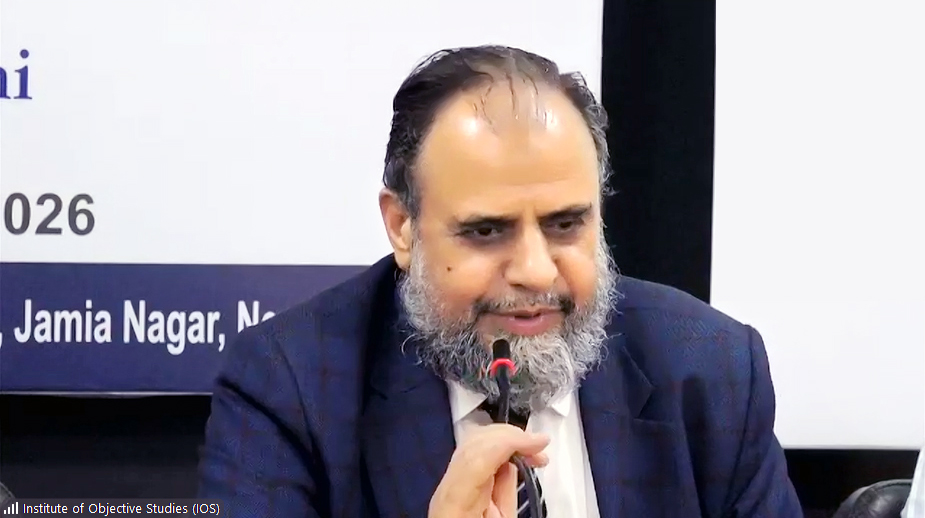
In his closing remarks, Prof. Mohammad Afzal Wani said that the lecture covered historical and contemporary aspects of the conflict. He noted that dominant political and economic interests play a major role in such conflicts. While the US continues to function under its Constitution, the Gulf region has become a battleground for power and resources. Due to its rich oil reserves, the region attracts global powers. He emphasised that Islam should serve as a moral, ethical, and humane force. He suggested that Iran should build stronger ties with other Muslim countries. He also stressed the importance of the United Nations in conflict resolution and highlighted the value of non-alignment in maintaining neutrality. He called for a global movement promoting peace and opposing war.
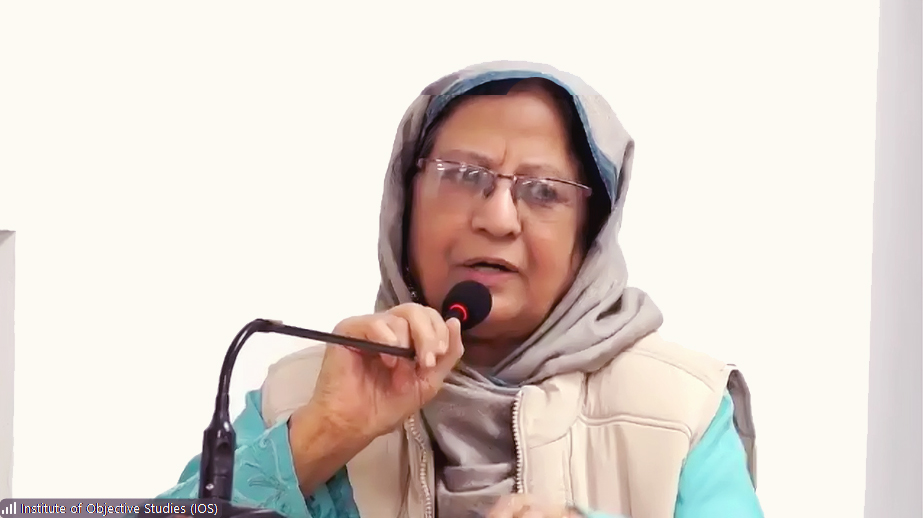
At the end of the lecture, Prof. Haseena Hashia presented a vote of thanks to the attendees.
Go Back