IOS-G.M. Momin Women’s College jointly organises two-day International Conference on “Philosophical and Ethical Prospects of Artificial Intelligence”
IOS-G.M. Momin Women’s College jointly organises two-day International Conference on “Philosophical and Ethical Prospects of Artificial Intelligence”
New Delhi: A two-day online international conference on ‘Philosophical and Ethical Prospects of Artificial Intelligence: Insights into Social, Scientific and Technological Implications’, was jointly organised by the Institute of Objective Studies, New Delhi and the departments of Philosophy, Zoology and Information Technology, KME Society’s G.M. Momin Women’s College, Bhiwandi, Maharashtra, on January 17 and 18, 2026.
Inaugural Session
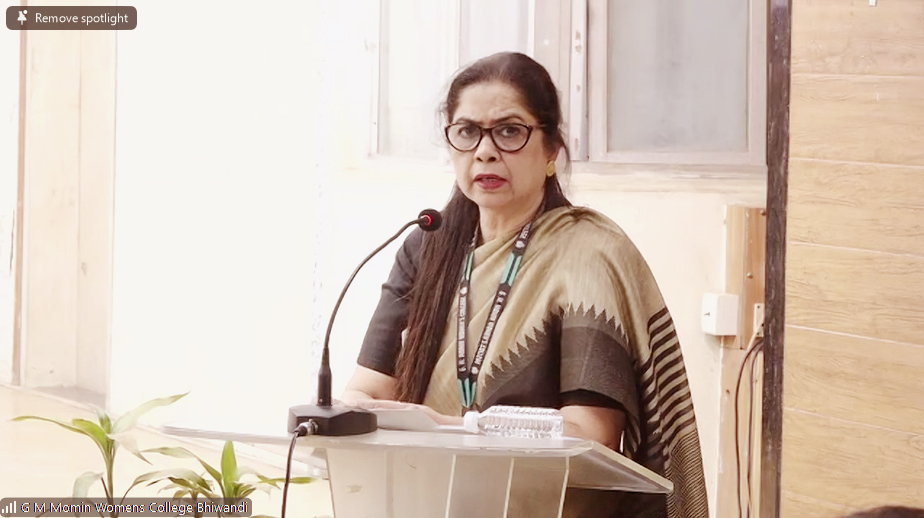
The conference began with the recitation of a Verse from the Qur’an by Mr. Umar Farooqi. Principal of G.M. Momin Women’s College, Dr. Tabassum Shaikh, in her welcome and introductory speech, introduced the college set up 27 years ago, under the aegis of the Konkan Muslim Education Society which ran several educational institutions and had strength of 25,000 students. This college was a minority Muslim institution that gave education to women. It was one of the lead 50 colleges in the region, affiliated to Mumbai University. The college was also implementing the New Education Policy scheme. She held that collaborating with the IOS was giving the college a boost to empirical research. She maintained that the Institute was the centre for research and intellectual pursuits and women uplift. The Institute also worked in the field of the empowerment of marginalised sections of society. It was the foremost think-tank of reason and research. Speaking about the Artificial Intelligence, she said that questions like “what to do and what not to do” still remained to be answered. She opined that human values could not be detached by science and that AI must be human-oriented.
.jpg)
In his key-note address, chairman of the IOS, Prof. M. Afzal Wani, observed that this was the second programme of collaboration with the G.M. Momin Women’s College. The purpose of the conference was to unlock certain mysteries surrounding AI. An American coined the term called AI. In this, Allah is depicted as some kind of nature. “We have to look back at the human history. Human society has something in terms of inheritance. AI is both used and misused. You can not achieve anything without the power of the Almighty. It is not a new phenomenon. AI is not natural because it was created by the human being. It is an imitation of nature. All the things were around the human being,” he said. He further noted, “We automated the capacity for human welfare. With the use of mind, we produce something. AI is related to thinking and producing, and we should take it as a challenge. Sometimes this is useful and sometimes not. The question is if a machine can do everything. Ethics says there should be no disrespect”.
Prof. Wani pointed out that AI had the capacity to be useful as well as harmful. “How AI has done things very fast? It helps running things and providing result-oriented output. It gives efficiency and has the capacity to reach planets, including earth which is not possible for humans. It has the capacity to give something fruitful as well as harmful. It has both positive and negative possibilities”. He said that AI data could also thieved. He called upon the journalists to take a responsibility to go deep into it and provide data to leaders, bureaucrats and the judiciary. He held that AI could also be misused. He called for codifying international law to prevent misuse of the AI and fix the responsibility in this regard. AI could, however, be useful for forecasting weather and disaster. Besides, it should have more power of guidance. Referring to the Revealed Knowledge, he said that it could regulate AI. “Reveled Knowledge always helped us”, he averred.
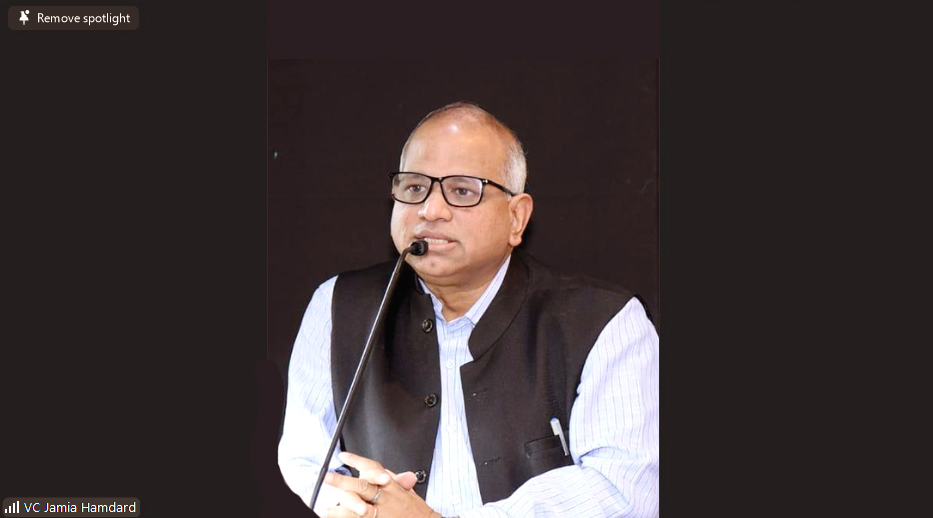
Speaking as a guest of honour, Vice-Chancellor of Jamia Hamdard, New Delhi, Prof. M. Afshar Alam, observed that AI asked us questions that were genuine in intelligence. It helped in learning, creativity, justice, dignity but had disadvantages too. Privacy was an issue in its use. But, at the same time, AI analysed and predicted human behaviour. AI had social implications too. He said that 40 percent workforce could be affected by the use of AI. Thus, there was a need to democratise the use of AI. How could the AI be used in a positive manner, was the moot question. He also stressed the need for determining how AI could be used with ethical values.
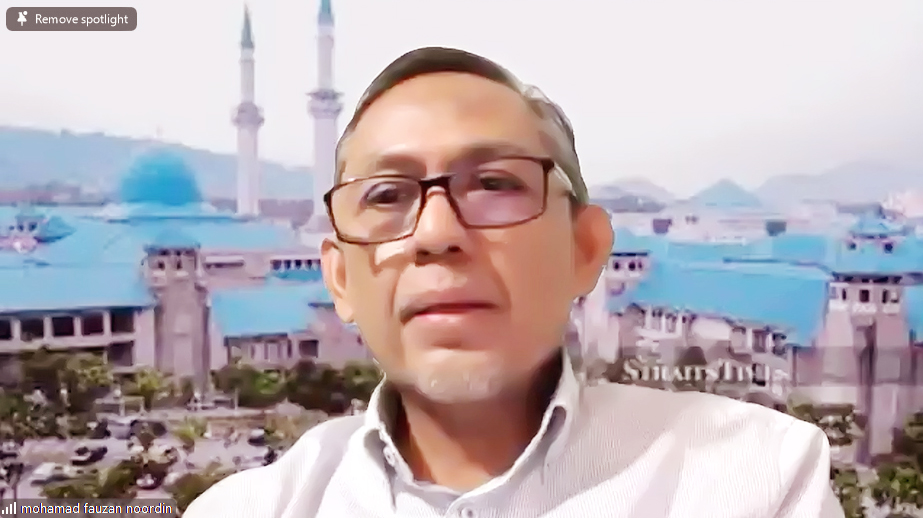
Another guest of honour was Prof. Mohammad Fauzan Bin Noordin, Deputy Rector, International Islamic University Malaysia (IIUM), who called for harmonising technology with human values. Commenting on the perils of AI, he said that it was expected to impact every single human being. Misuse of AI in Japan was a case in illustration. Humanistic education in digital form was necessary. AI wanted to become human and human beings wanted to be come robots. Here the sense of belonging got killed. Thus there was a universal crisis. Knowledge led to chaos and AI was not immune to it. He said that de-humanisation should be avoided and empirical perception be guided by ethics. He called for re-connecting Revealed Knowledge with divine values (Tawhid). The theory that AI had individualistic value, should be rejected. Referring to Sunnah and Iqra, he said that the highest knowledge was wisdom. He laid emphasis on developing AI with Adab.
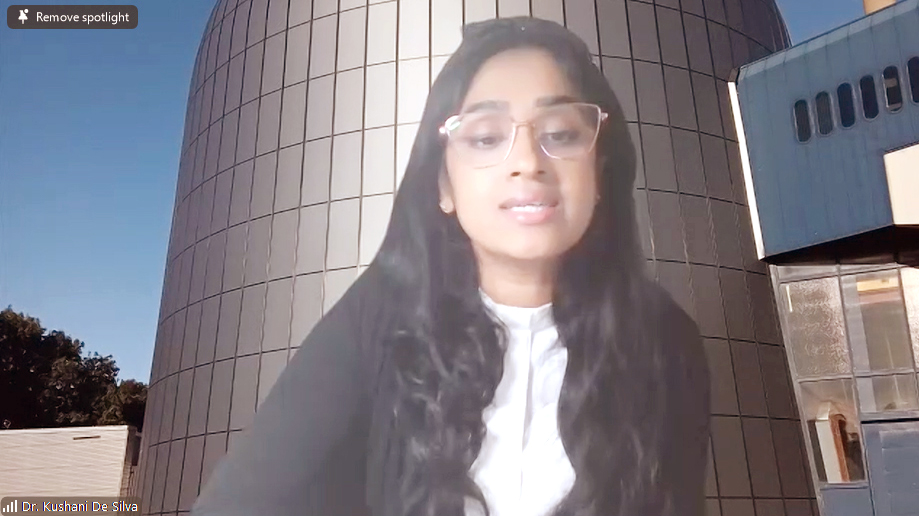
The third guest of honour was Dr. Kushani De Silva, subject matter expert, CRDF Global; UN Expert in Strategic Risk Reduction, Sri Lanka. She spoke about the important dynamics of the use of AI. It was necessary to understand how best could AI be used. AI was not only the technological innovation, but it also had a philosophical dimension. She held that AI could connect with people globally. Technologically, it was a powerful tool. It could also impact one’s critical thinking pattern. Warning against the danger of the development of chemical weapons, she said that they could be easily developed by the help of AI. With ethical thinking, this danger could be minimised, she opined. She laid emphasis on ethical framework of AI as also the examination of its critical challenge and monitoring. In AI, there was lack of responsibility, and to make responsible, regulations could be globally made. She called for enhancing human performance.

Speaking as the chief guest, Prof. Mario Wenning, Universidad Loyola Andalusia, Spain, who comes from philosophical background, said philosophy of technology was hundred years old. He held that data did not liberate reasoning. There were ethical and philosophical challenges of AI. He spoke about the temporality and the impact of technology. Scholars were concerned about the impact of new technology and its uncertain future. Rapid escalation of technology had several dimensions. Then there was temporal dimension. Recent technological changes gave rise to the latest philosophy and technology and increase of barbarism, he added. New networking platforms and cultures had emerged. He also explained the philosophy of rhythms, ethical and philosophical challenges of AI.
The occasion was also marked by the release of the journal and Abstracts Booklet of the said conference.
In his presidential remarks, professor of Political Science, Aligarh Muslim University, Aligarh, and Vice-chairperson of the IOS, Prof. Arshi Khan said “We are dealing with the critical phase of AI. Human being is leading a human life. There is crisis of democracy, trust and institutions. There was an age of pre-modernity beginning with Renaissance. Age of modernity cannot be achieved with pre-modernity. This is the age of post-modernity. There is the age of radical change that means the age of AI or automation”. He held that about 200 billion dollars had been invested in AI business. “They say AI is based on Algorism which is based on Algebra. Originating from the name of 9th century Persian mathematician, Musa al Khwarizmi, it means the system of decimal numeration”. “Who are the main players in the field? They are Microsoft and Amazon. They have their own softwares.” He said that AI made claims beyond horizon. Some of the claims of prediction by AI were found incorrect. Profitability was their main purpose. Prediction was good but the designing was problematic. Human and social issues were involved in AI, and the privacy was endangered. There was commodification of AI. However, through AI, human being was connected to space, time, geography, etc. Children were playing video games and hospitals digitalising the data. But the privacy was a problem. AI might be good and a boon. He noted that the IOS collected data on minorities in South Asia. AI could be made humane and social, he added.
Technical Session-I
The first technical session was focused on Social Sciences. Prof. Akbar Husain, ex-professor of Psychology, Aligarh Muslim University was in the chair.

The first speaker was Dr. Kamla Srinivas, SIES College, Mumbai. She spoke on philosophical and ethical prospects of AI. She mentioned the name of the Greek philosopher Protagoras in connection with assertion that “Man is the measure of all things”. She explained the humanistic essence of philosophy and science. Then she spoke about ‘Triadic Reciprocal Social Cognitive theory’ which states “that human functioning is shaped by the continuous, bidirectional of three factors: personal (cognition, emotion biology), environmental (social, physical context), and a behavioral (action). She discussed structure of knowledge which refers to how information is organised, connected and represented. She also shed light on dialectical synthesis which is the third step in Hegelian dialectical process, where opposing view-points or contradictory forces are resolved into a new higher understanding. She explained Protagorean Relativism in the age of Algorithms. In AI paradigms, there were machine learning modules. She stated that philosophy and science were humanistic disciplines. She held that philosophy, science and technology were interwoven.
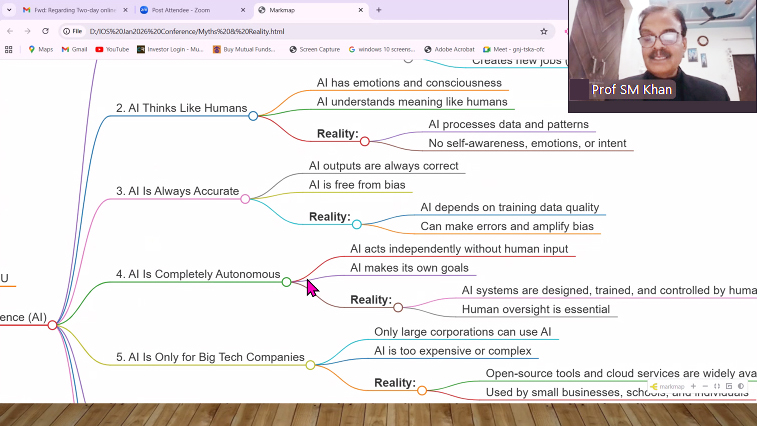
Prof. S.M. Khan, department of Psychology, AMU, Aligarh was the second speaker who observed that AI was the most profound technological development in human history. He allayed fears that AI would replace all human job. AI did not have emotions and intent. It required a lot of data and information. He said that myths were in circulation due to media and the lack of knowledge among people. Clinical and educational performance-based jobs were the domain AI. It had scientific paradigms. It reduced subjectivity. He held that it could assess millions simultaneously at the minimal cost. About 500 companies held over 70 percent fortune. It had increased accessibility and reduced cost. There was the question of accountability for consequences of AI deployment. He called for taking responsibility of AI with caution.
The next speaker was human rights activist, Delhi, Mr. Vidya Bhushan Rawat. He observed that the war on intellectualism was going on for the last 10 years, and all the intellectualism was based on narratives. This was very dangerous because of being digital colonialism. Digital colonisation led to the kidnapping of the Venezuelan President, Nicolas Maduro. He said that discovery of India by the Portuguese sailor, Vasco da Gama was made a narrative and the narrative was Europe-centric. AI had huge dimensions and global multinational corporations were dominating the world. He concluding saying that the knowledge was based on western narrative.

The fourth and the last speaker of the session was assistant professor of philosophy, Miranda House College, Delhi University, Dr. Tarang Kapoor. She called for developing AI as a common good. There was a question of autonomy. She said, “AI is playing a doctor and we are playing a patient”. Consulting therapy through AI chat had become possible. It should be held to accountability. She stressed the need for maintaining trust among the people about AI.
In his presidential observation, Prof. Akbar Husain suggested that AI should be treated as an active intellect. AI helped in medical and healthcare. It helped medical profession by diagnosis, prescription and surgery. He opined that inequality would be there due to hegemony of AI industry. He said that health was an area where AI could greatly contribute.
Technical Session-II
The second technical session was chaired by Prof. Amita Valmiki, former professor and head of the department of Philosophy, Ramiranjan Jhunjhunwala College, Mumbai.

The first speaker of the session was Prof. Nasrin, department of Education, AMU, Aligarh. She spoke on ‘Academic integrity in the age of AI: Challenges and prospects’. She said that there was paradigm shift from classroom to evolution of academic integrity. In Greek civilisation, academic integrity emerged from Socratic ideals emphasising virtue, truth and individual moral responsibility in the pursuit of knowledge. In the 21st century, academic integrity had expanded to include ethical use of intelligent machines where human values must guide AI-driven knowledge creation. In the age of AI, excessive reliance on knowledge eroded the will to learn, weakening creativity, critical thinking and scholarship. Erosion of learning and critical thinking were the challenges of AI. Other challenges included automated plagiarism and data falsification. She also drew attention towards bias in AI-generated context.
The second speaker was Dr. Md. Aftab Alam, associate professor of political science, Dr. Zakir Husain Delhi College. He argued that the usage of AI in learning posed challenges. There were so many concerns of AI in political science. Democracy, social concerns propaganda and public opinion were some of them. He explained why ethics of AI mattered in social sciences. He said that it was used in policing and social welfare. He held that big powers maintained surveillance through AI. Facial recognition was also done by AI. There were other issues like, bias, lack of fairness and discrimination in AI. Historical data was used for discrimination. He called for re-examining bias and inequality issues. He raised the question as to who benefited from AI. AI came from global perspective whereas it should come from cultural and regional perspective.
The third speaker was Dr. Khwaja Md. Ikramuddin, professor, Centre for Indian Languages, Jawaharlal Nehru University. He spoken on “How to use digital technology, i.e., AI and its use in Urdu teaching.” He said that though machines could not replace man, yet the distance between the two was narrowing. And one day this distance would also disappear. “We have not as yet understood how AI could bring about change in our lives.” He described AI as a ‘treasure trove’ for teaching. Sound system was very important in the language teaching. “Tools for learning language through sound are available free of cost. Any language can be learnt through these tools. Urdu literature and language can be learnt through digital technology”, he added.
The last speaker was Dr. Simmin Bawa, assistant professor of philosophy, Jai Hind College, Mumbai. She held that AI was transforming education via tutoring systems, analytics and adaptive platforms. It raised the ethical question if AI was nurturing intellect or human cognition. AI risked Algorithmic nudging. AI also reinforced passive learning and lacked transparency. AI should be used as a tool for nurturing intellect. Thus there was a need to balance AI and human wisdom. She said that AI should empower and not replace education.
Technical Session-III
The third technical session was chaired by Prof. Amita Valmiki.
The first speaker was Dr. Abhay B. Fulke, principal scientist, CSIR-NIO (National Institute of Oceanography), Government of India. He spoke on the AI-based approach to plastic bio-mitigation. He described plastic pollution as a monster pollution in the world. He suggested that AI should be used with truth, action and dignity.
He was followed by Dr. (Ms.) Madhulika Goyal, senior project manager, FOSSEE, IIT, Mumbai. She said that she believed in quality education. She explained the ways to use AI for education and research. She said that AI was man made. It collected data, learnt and predicted what was next. This was called predictive data. Then came generative data which created new images, videos, etc. She held that AI was a tool that could be used for searching, understanding, organising and analysing. AI was scientific tool, but the ethical challenges were involved in it. She noted that it raised the questions about fairness, bias, transparency, accountability, privacy, regulation and governance.
The third speaker was Dr. Muhammad Inamullah, assistant professor, department of computer engineering, AMU. He defined AI as ‘a technology that performed tasks without human intervention.’ It was used for automation, pattern recognition and predictive capabilities, he added. He was followed by Dr. Nida Fatima, assistant professor, School of Science and Technology, Haryana. She observed that human well-being should be at the centre. AI should have multi-stake holder collaborators. Accountability was an ethical requirement in AI. Transparency was also necessary in it. Dr. Mohammad Sufian Badar, assistant professor, department of computer science and engineering, Jamia Hamdard, New Delhi, was the last speaker who expounded how AI impacted society. He said it was applicable in all fields, including law enforcement. There might be slight mistake in the identification of cancer by use of AIML. Slight mistake in identifying nuclear facilities could spell disaster. If one could target a nuclear site, the slightest mistake could be disastrous. AIML was good, but one had to be cautious. He held that AI could not replace human being.
Day-2, January 18, 2026
Technical Session-IV
Chaired by Prof. S.A.M. Rizvi, professor, department of Computer Science, Jamia Millia Islamia, New Delhi.
The fourth technical session had Prof. Mansef Alam, professor of computer science, Jamia Millia Islamia, as the first speaker of the session. He spoke on the ethical use of AI in research and real life. He said, “We are mollifying the data and you have to mollify honesty and fairness”. He held that there were five pillars of AI ethics. Citing AI in academic work, he held that it was essential as guidance for properly acknowledging generative AI tools.
He was followed by Mr. Faiz Chachiya, senior cloud solution architect at Microsoft, Mumbai. He spoke on philosophical and ethical prospects of AI. He said that building AI required a different approach. He noted that security could not be ignored.
The next speaker was Dr. Faisal Anwar, assistant professor of Computer Science, AMU, Aligarh. He focused on technical, ethical, social and government policy risks of AI. He said that policies should be country-specific. Technical risks involved lack of robustness, security and hallucination. Governance and policy risks involved lack of regulation, accountability gaps, weaponisation and its misuse. And ethical and societal risks involved bias and discrimination. They might be common biases or stereotypes, he added.
The fifth speaker was Dr. Faraz Masood, guest faculty, department of Computer Science, AMU. He touched upon the topic ‘Human-AI co-existence, technical mechanism, influence pathways and ethical risks’. He said that training data acted as a historical values carrier. RLHF transformed human preference into anchored norms. Token probabilities created invisible framing effects. High fluency derived cognitive offloading and reliance. He noted that ethics depended on deployment, not intelligence alone. Intelligence without conscience was incomplete, he averred.
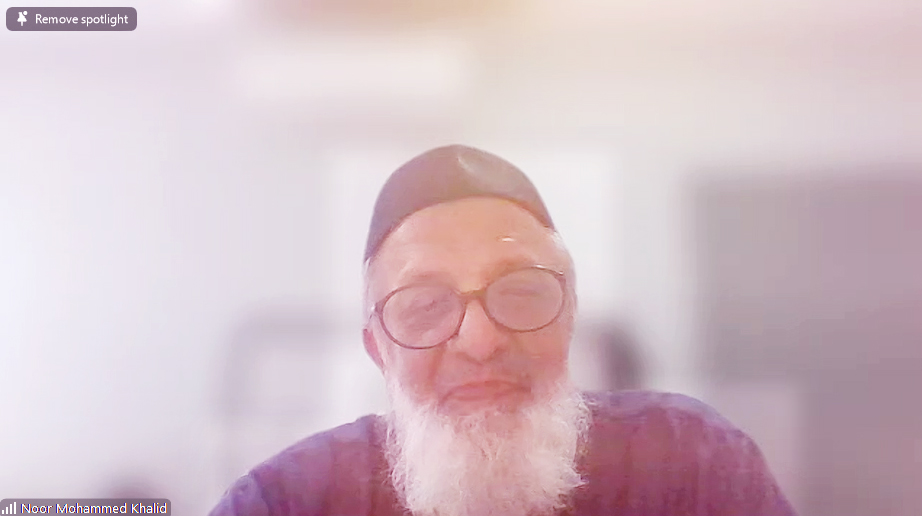
The last speaker was Mr. Khalid Noor Mohammed, senior researcher, International Islamic University, Malaysia. He elucidated how ethics could be applied in AI from Islamic Shariah angle. There were Maqasade-Shariah. AI was transforming society, but ethical and philosophical issues were also involved in it. Healthcare, education and justice issues were addressed by AI but, it was putting a large number of people out of job. He called for protecting from harm to the people by AI. AI offered a lot for human development. “Ethics is a conduct guided by moral values. We are far behind the legal framework. Ethically, we don’t have a uniform system”, he said.
Technical Session-V
Dr. Namita Nimbalkar, professor, department of Philosophy, Mumbai University, chaired the session, which was based on presentations. Dr. Zeenat Surve’s was the first speaker who spoke about her review article on ‘AI in wildlife tracking: A new approach to Habitat Conservation.’ She discussed key benefits of tracking and outcome of the study and its impact. She put focus on challenges, data bias and infrastructure needs. She was followed by Dr. Kamla Srinivas and Sudha Bagavatiswaran. They focused on ‘Digital selves and synthetic souls: Revisiting Consciousness, moral standing and personhood.’ They re-examined the consciousness, moral agency and personhood. They viewed them through philosophical and IT-interdisciplinary lens. This was coming together of AI and humans. The next speaker was Nilkanth Sharma, who centered his paper on ‘Water quality monitoring of coastal polluted water bodies for developing ML Algorithms: A future tool. He discussed environmental parameters and detection of early warning system. He was followed by Mr. Siddant Ratanpal, who spoke on ‘AI-driven real time monitoring of Fecal Coliforms in coastal ecosystems.’ He explained use of AI for fecal pollution indication. The fifth speaker was Mr. Nilesh Meghram who touched upon ‘AI and erosion of human morality: A Buddhist approach.’ He said that AI was alleged to replace human resource. AI was not in itself an independent phenomenon. The sixth presenter was Dr. Savitha Sukumar, who dilated on ‘Rebooting the human analysing relationships and values in literature and film. The next speaker was Miss Zara Bukhari, who spoke on ‘The AI dividend dilemma: Wealth creation, concentration and financial ethics’. She explained why AI favoured capital over labour. There was concentration of market power and shift from wages to assets. Then she spoke about the global divide and AI colonialism. She also touched upon environmental and resource costs. She discussed pathways to inclusivity.
Miss Rafat Khan and Miss Snehlata Agarwal were the last speakers who jointly presented their paper on ‘Wildlife tracking and habitat conservation with AI.’ They discussed evolution of wildlife conservation technology. They held that the conservation might threaten bio-diversity and migration route of animals. They said that camera track was also for the collection of data on migration of animals. GPS tracking was enhanced by machine learning. GPS technology was connected to the satellite. AI-powered camera traps revolutionised wildlife monitoring, they added.
Valedictory Session
The closing session of the two-day online international conference began with the recitation of a verse from the Qur’an by Dr. Tabassum Sheikh. Prof. Dr. Rashid Ali, department of Computer Engineering, AMU, Aligarh, was the guest of honour. Addressing the conference, he said that AI was there to use human intelligence. Allaying fears that AI would take jobs, he maintained that it was being applied in several fields. Whether it was social sciences, humanities or other sciences, it was applied in diverse fields. It was applied in healthcare field as well. CT scan images, diagnosis and the state of diseases were the fields in which AI was applied. People were getting real benefits from AI. But, he added, AI could not replace doctors because medical ethics was there. AI could be helpful in agriculture too. In business, retail giants like Amazon and Flipkart were operating through AI. In the field of education also, researchers wanted to use AI. He said, “We should solve our problem, but we must also know our problem. We should design our problems and then use AI for their solution. AI is interdisciplinary”.
Speaking as the chief guest, Dr. Priya Vaidya, professor and head of the department of philosophy, Mumbai University, described the conference as a roadmap to show the way ahead. Touching upon the fundamental problems of AI, she said that ethics was very important from the philosophical angle. She advised against over-reliance on AI. Referring to bias, she said that it should be seen that the modules developed were not biased. “We have fantastic wisdom which we must use. We have to develop systems which are not harmful. We must see what is right and what is wrong. We can receive direction from AI, but we can not copy-paste it. AI provides power-points, but the machine does not have the mind we have”, she observed. However, certain questions, like, who should take the responsibility or accountability of the data, arose. She called for strengthening of human brain. She asked to enhance one’s ability and improve the understanding of AI.
In her presidential speech, Prof. Amita Valmiki, observed that John McCarthy, an American computer scientist coined the term Artificial Intelligence in 1955. She said that the value of a human being weas very important. Research should have a human face. She asked, “Are we are losing a human being?”. Or, “Will we be reduced to puppets or remain human beings?”. So, there were ethical dimensions of AI as well. She termed AI as a commendable human endeavour. She also posed questions like, moral justice and legal justice by AI. It must be seen how much one could take moral justice on AI. It would provide results according to command. AI had subjectivity and thus there was a need to distinguish between good and right. AI took data from historical sources which might be biased. She noted that AI could solve complex issues within seconds. It was a magic wand if it did not encroach upon one’s identity and personality, she concluded.
At the end, Dr. Tabassum Shaikh, thanked the IOS for providing a panel of speakers drawn from JNU, JMI and AMU, and collaborating with the college, making the conference very fruitful.
Earlier a 7-point resolution unanimously adopted by the participants of the conference, was read out by Dr. Mansha Ansari. The resolution read as:
It is a matter of immense satisfaction that the Department of Philosophy, Zoology and Information Technology, K.M.E. Society’s G.M. Momin Women’s College, Bhiwandi, M.S. in collaboration with the Institute of Objective Studies, New Delhi, successfully organised a two-day Online International Conference on “Philosophical and Ethical Prospects of Artificial Intelligence: Insights into Social, Scientific and Technological Implications” on January 17-18, 2026.
The conference brought together scholars, scientists, technologists, philosophers, legal experts, policymakers, and civil society representatives to deliberate on the rapid expansion of Artificial Intelligence (AI) and its far-reaching implications for human existence and civilisation. The enthusiastic participation of students significantly contributed to the effective conduct of the event.
After due deliberation, the house unanimously adopted the following resolutions as the basis for future action:
1. In view of fact of human relations and activities being immensely influenced by Artificial Intelligence resulting into critical levels of entanglements in performances and momentous corrosion of human values, the academics, professional and policy makers should work with necessary diligence and consistency to minimise implications and explore ways for safer and regulated use of artificial intelligence.
2. Thoughtful initiatives should be taken up by governments and educational bodies to integrate the understanding and use of artificial intelligence with systems of education and curriculum to prepare the next generation of human being for a safer use of artificial intelligence with least susceptibility and vulnerability.
3. In the absence of a required vigorous legislative action related to use of artificial intelligence so far, both at the national and international levels, a globally acceptable regulatory framework should be worked out to establish governing norms and enforcement mechanisms, for a guided and more purposive role of artificial intelligence.
4. In pursuance of the principle of regulating ‘technology by technology’, deliberate efforts must be made to promote advanced research for producing innately protective devices and applications for use of artificial intelligence.
5. The role of the agencies of social control, including religion and prime cultural norms, should be extended to practices of use of artificial intelligence with best of their ethical, moral and spiritual strength.
6. Realising the capacity of artificial intelligence to enable concentration of power in certain hands, the United Nations and other globally influential institutions and bodies, should work to prevent monopolisation of use of natural resources, motivated implementation of international policies to the advantage of any particular nation or group, in exclusion to others.
7. The Institute of Objective Studies should continue its programming (commenced in 2019) on the understanding and use of emerging technologies and artificial intelligence for fine and conscious literacy of the society, especially younger generation, appropriate to the expected technological disasters, through use of revealed knowledge and human ethics, in collaboration with institutions of excellence like G.M. Momin Women’s College, Bhiwandi, and others.
The conference ended with a vote of thanks extended by the vice-chairperson of the IOS, Prof. Haseena Hashia.
Go Back