IOS Celebrates “Constitution Day”
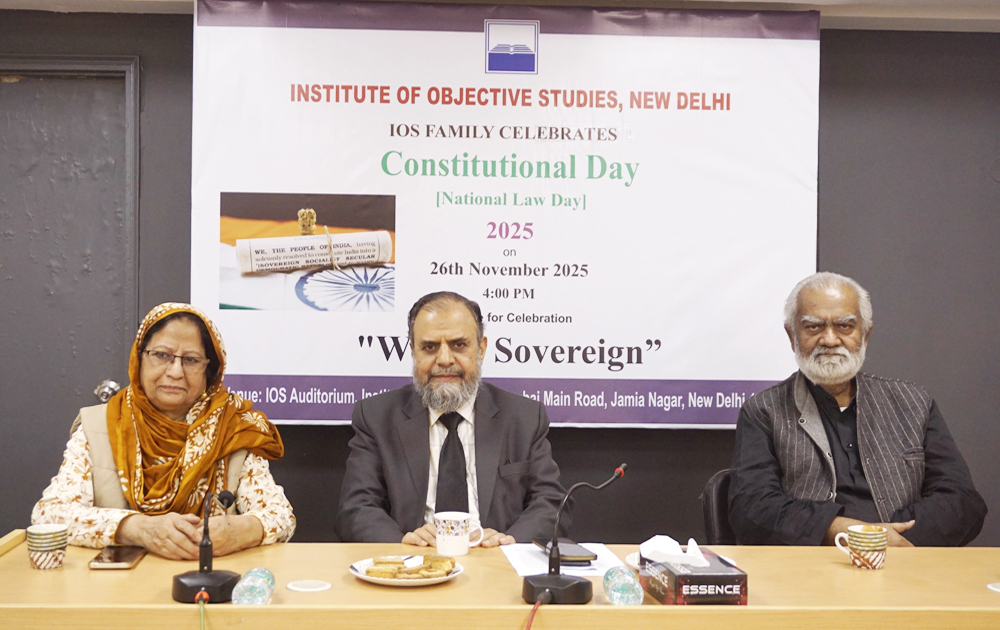
IOS Celebrates “Constitution Day”
New Delhi: A function to celebrate the Constitution Day (National Law Day) was organised by the Institute of Objective Studies at its auditorium on November 26, 2025. Themed as “We are Sovereign”, the function was attended by the members of the staff of the IOS.
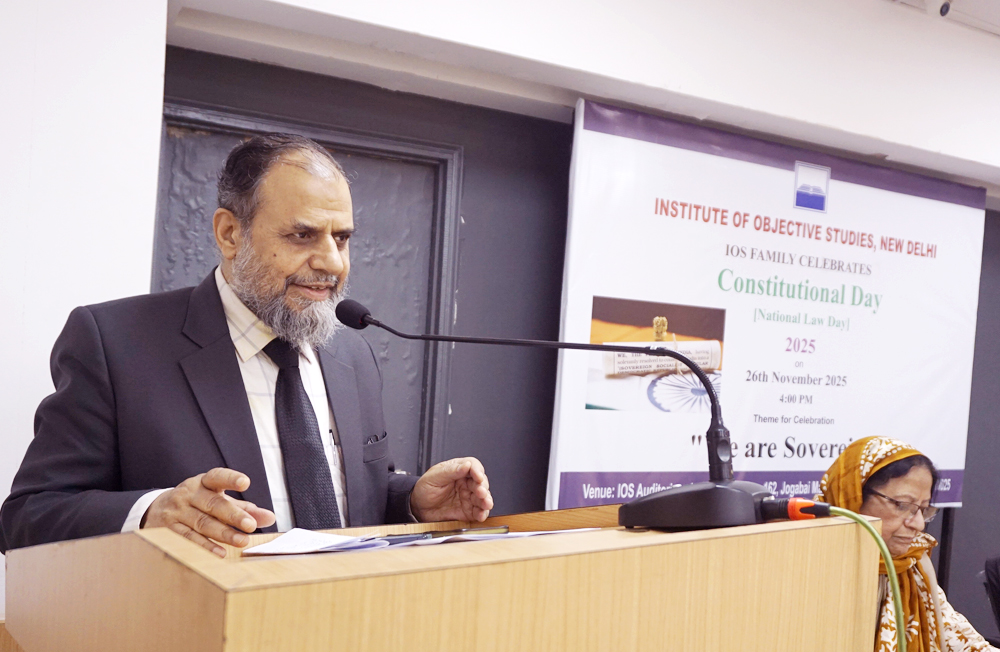
Addressing the gathering on the occasion, the chairman of the Institute, Prof. M. Afzal Wani, said: “On this very day in 1949, the Constitution of India was adopted. The Constitution was adopted after three-year long debate in the Constituent Assembly. The Constitution was the outcome of the understanding reached after long discussions and hard work”. He opined that the First World War and the Second World War were not as big events as was the emergence of India as the largest democracy on the world map. This was the day to celebrate the largest Constitution of the largest democracy. In order to understand the importance of the Constitution and its finer points, four billion people of India should connect to it. They should figure out the agenda of the Constitution. He called for understanding this agenda to enable India to shine in the world. Without this, no idea could come out and no action plan could be drawn up. Even the strength could not be gained without this agenda. “It is for us to discern what it contains. Some people say it has been borrowed from somewhere else and given a shape with a cut-paste. But I believe the Constitution of India grew out of the freedom struggle”. He noted that the framers of the Constitution saw to it that there remained no shred of sufferings and excesses.
In this connection, Prof. Wani referred to the martyrdom of the Urdu journalist and editor, Moulvi Mohammad Baqir who was strapped to a cannon and shot reducing his body to pieces in 1857. The entire country was united then to demand freedom of expression. Those who averred that the Constitution was brought from somewhere, were wrong. The IOS deemed it fit to hold a national conference in remembrance of Moulvi Baqir who laid down his life at the altar of press freedom. Referring to the IOS, he said that it was a value-based institution, working for the good of the humanity. The Institute was engaged in conducting research in consonance with the spirit of International Bill of Rights. It carried out research in terms of values enshrined in the Indian Constitution. This was also an apex research body at the national level. Owing to being an institution of objective research, the IOS had an international mission. It was oriented to both the Indian Constitution and the International Bill of Rights. He observed that the Institute was taking forward its research and agenda in conformity with the voice of the votaries of rights. This Institute did a lot of works in support of constitutional values during 40 years of its existence. The IOS was not found wanting in respect of discussion on the Constitution anywhere in the world. Be it the United States, the United Nations, Africa, Asia or an unexpected continent or a planet like, Mars, the IOS research would be useful everywhere.
Prof. Wani pointed out that the IOS took Constitutionalism forward under the able direction of its chief patron and founding-chairman, Dr. Mohammad Manzoor Alam, whose vision and acumen held it in good stead. In a way, the Institute was a movement which devoted itself to the well-being of humanity. Legislators, researchers, teachers and students of colleges as well as activists could utilize the findings of the researches undertaken by the Institute. Those who wanted to restore peace and order in the world, and to develop cordial relations among nations, could also benefit from the plethora of material put together by the IOS. He said that the IOS family was imbued with the spirit of the Constitution which was a testament to human welfare. The caravan of the Institute would continue its journey to work for social uplift. He said that the day was called the ‘Constitution Day’ in the entire country because among other things, it also articulated the improvement of relations with other nations. Extending his felicitations on the occasion, he laid stress on understanding the Constitution in letter and spirit, and speculate on the disorder that might follow in the absence of it.The occasion was marked by the pledge the staff members of the Institute took to stand by the Preamble to the Indian Constitution.
Go Back