INSTITUTE OF OBJECTIVE STUDIES, NEW DELHI (INDIA)
in collaboration with
ALIJA IZETBEGOVIĆ FOUNDATION,
BOSNIA AND HERZEGOVINA |
AHAS KIRKHS, INTERNATIONAL ISLAMIC UNIVERSITY MALAYSIA |
UNIVERSITAS IBN KHALDUN BOGOR, INDONESIA |
IBN HALDUN UNIVERSITY, ISTANBUL, TURKEY |
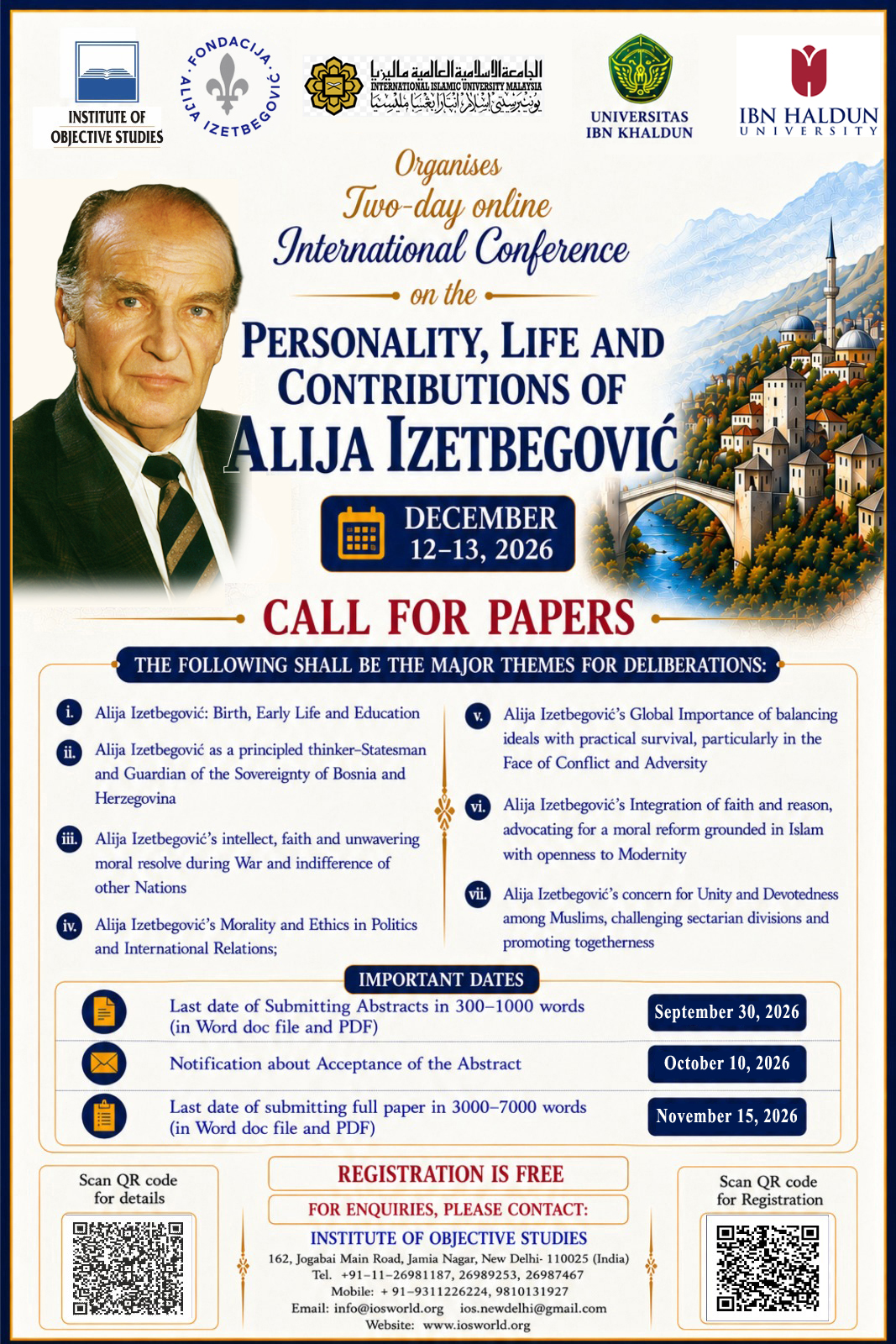
Two-day online International Conference on the
"Personality, Life and Contributions of Alija Izetbegović"
December 12-13, 2026 via Zoom
|
| |
IN RETROSPECT
Bosnia and Herzegovina is a South-East European country (on the Balkan Peninsula), which borders Serbia, Montenegro and Croatia and has a coastline of about 20 kilometers on the Adriatic Sea. With a moderate continental climate, it has hot summers and cold and snowy winters. Bosnia and Herzegovina currently has the population of around 2.9 million (about 1.5 million Bosniaks, 0.9 million Serbs and 0.45 million Croats, and 17 recognized “national minorities” including Jews, Roma, Albanians, Montenegrins, Ukrainians and Turks).
Bosnia and Herzegovina has a bicameral legislature and a three-member presidency, each from the main ethnic groups (directorate system). The state is decentralized, reorganized by the Dayton Peace Agreement into two autonomous entities and a district—the Federation of Bosnia and Herzegovina, the Republika Srpska, and the Brčko District (governed by its own local government). The central government has limited powers over foreign affairs, defense, monetary policy, security, part of the judiciary, foreign trade and economic relations, transport and communications, civil affairs and human rights. The state is a member of the United Nations, the Council of Europe, the Organisation for Security and Co-operation in Europe, the Central European Free Trade Agreement, and is also a founding member of the South-East European Cooperation Process. Bosnia and Herzegovina has been an European Union candidate since 2022, and a candidate for the North Atlantic Treaty Organization membership since 2010.
Bosnia has a very complex history since at least the Paleolithic period. Significant cultures such as Butmir and Kakanj appear to have emerged along the Bosna River during the Neolithic period. The Butmir culture, flourishing around 5100 to 4500 BC, is well known for its idiosyncratic pottery and anthropomorphic figurines. Intricately decorated ceramics and realistic human figures from this culture have been uncovered by excavations near Sarajevo.
Slavic peoples settled in Bosnia during the 6th and 7th centuries, and by the 12th century Bosnia arose as a vassal state under local monarchs. Bosnia became an independent medieval kingdom in the 14th century, with King Tvrtko I (1377–1391) as its leader. Through this Bosnia established a distinct political and cultural diversity. In 1463, Bosnia became an important province of the Ottomans, who introduced administrative restructurings, urban expansion, mosques, inns and bridges, and marketplaces, promoting Sarajevo and Mostar as major cultural jurisdictions. Bosnia grew into a recognized area of religious plurality, with Muslims, Christians and Jews living together. In 1878, after the Congress of Berlin , Austria-Hungary occupied Bosnia and formally annexed it in 1908. The new administration streamlined infrastructure, governance and education. Nevertheless, separatist tendencies grew among Serbs and Croats. In 1914, Bosnia attracted global attention due to the assassination of Archduke Franz Ferdinand (he was the heir to the throne of Austria-Hungary) in Sarajevo, carried out by a Serbian nationalist organization and which triggered the World War I. At the end of the World War I, Bosnia became a component of the political creation (the Kingdom of Serbs, Croats and Slovenes), later Yugoslavia.
The World War II was a catastrophic period for Bosnia, which suffered bloody violence and ethnic war under fascist occupation, and genocide was committed against Bosniaks. After the end of the war in 1945, Bosnia and Herzegovina emerged as one of the six republics of socialist Yugoslavia ruled by the Communist Party led by Josip Broz Tito. That period is mostly remembered for industrialization and virtual harmony among Bosniaks, Serbs and Croats. Tito led the country from 1945 to 1980, advocating strategic neutrality with a command economy, which later transitioned from a command economy to market-based socialism. However, it faced major economic difficulties and growing Serbian chauvinism.
Economic collapse and intensification of nationalism resulted in the Yugoslav wars, causing Slovenia and Croatia to secede in 1991. Finally, the federation collapsed on April 27, 1992, with Serbia and Montenegro remaining as the Federal Republic of Yugoslavia. With the disintegration of Yugoslavia, Bosnia and Herzegovina declared independence in 1992 which led to aggression by the Yugoslav army that helped the rebellion of part of the Bosnian Serbs. The war brought horrific ethnic cleansing of Bosniak Muslims, prolonged sieges and massacres, especially including the shocking genocide against Bosniaks in Srebrenica in 1995.
The suffering ended only with the Dayton Peace Agreement. Bosnia and Herzegovina is an independent but politically intricate and complex state with a system of power-sharing among Bosniaks, Serbs and Croats. In any case, from the medieval kingdom to today, as an Ottoman province, Austro-Hungarian territory, Yugoslav republic or modern independent state, Bosnia continues to be a unique multicultural society in Europe.
ALIJA IZETBEGOVIĆ IN PERSON
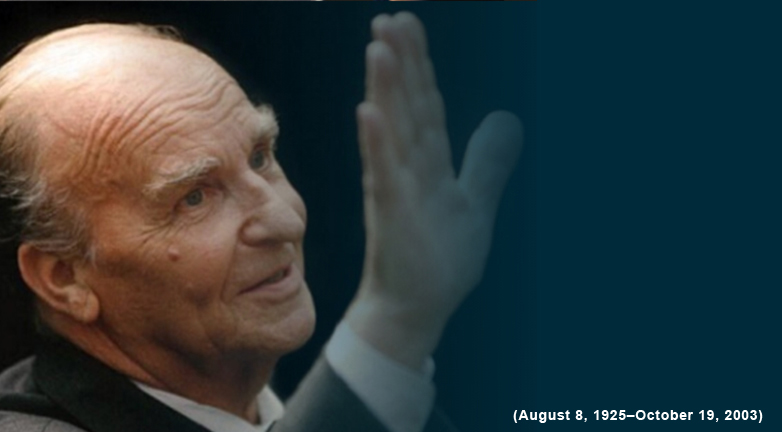
Against this background appears the prominent Bosnian personality, Alija Izetbegović (August 8, 1925–October 19, 2003), a political leader, Islamic theorist and writer who was the president of the Presidency of the Republic of Bosnia and Herzegovina from 1990 to 1996, and a member and rotating chairman of the Presidency from 1996 to 2000. Alija Izetbegović was also the first president of the Party of Democratic Action and its founder.
EARLY LIFE AND EDUCATION
Izetbegović’s paternal grandfather, also called Alija, was from Belgrade, while as a soldier in Üsküdar, he married a Turkish woman named Sidika Hanim. After violence that broke out against Bosniaks in Serbia, he moved to Bosanski Šamac in Bosnia with his wife and five children. Izetbegović’s father, a merchant, was mobilized into the Austro-Hungarian army during the World War I, on the Italian front and suffered severe injuries that left him semi-paralyzed. In 1928, the family moved to Sarajevo, where Izetbegović (then 3 years old) received a secular education. In 1941, he helped found the association “Young Muslims”, a youth activist organization. He remained politically active until his first arrest in 1946 by the communist authorities. Izetbegović completed his law studies at the Faculty of Law of the University of Sarajevo. cont'd...
|
.jpg)

Click here



Registration is FREE, but all delegates should register online through the link given below:
https://forms.gle/AYmQ3WYJsXMKEhHg6
Link for attending the conference via Zoom will be shared in advance to the delegates who have successfully registered.
CONTACT US
Institute of Objective Studies
162, Joga Bai Main Road, Jamia Nagar
New Delhi –110 025 (India)
Tel. +91-11-26981187/ 26987467/26989253
Mob.: +91 9311226224, 9810131927
E-mail: info@iosworld.org
Website: www.iosworld.org |
|
|