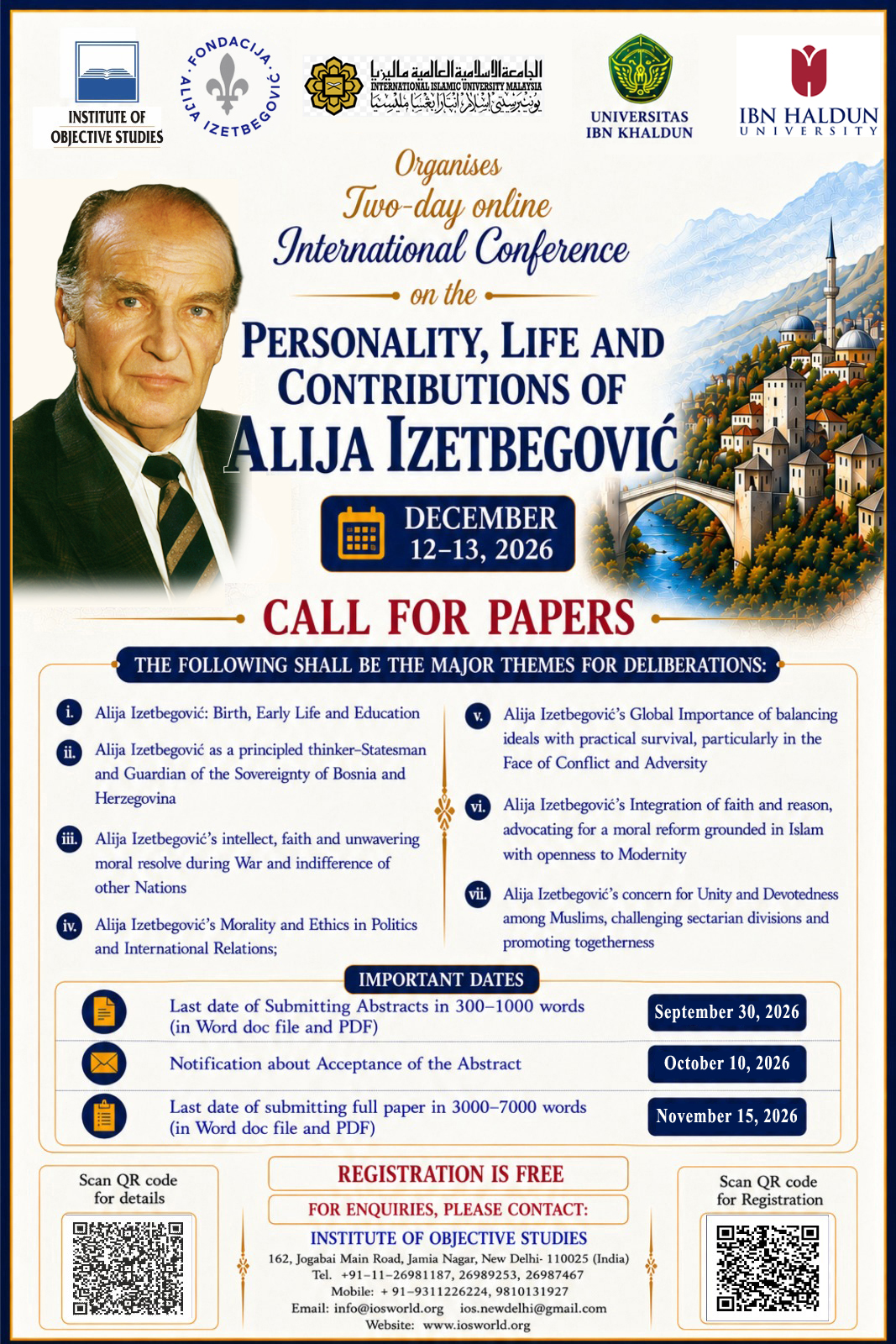
INSTITUTE OF OBJECTIVE STUDIES, NEW DELHI (INDIA)
in collaboration with
ALIJA IZETBEGOVIĆ FOUNDATION,
BOSNIA AND HERZEGOVINA |
AHAS KIRKHS, INTERNATIONAL ISLAMIC UNIVERSITY MALAYSIA |
UNIVERSITAS IBN KHALDUN BOGOR, INDONESIA |
IBN HALDUN UNIVERSITY, ISTANBUL, TURKEY |
Two-day online International Conference on the
"Personality, Life and Contributions of Alija Izetbegović"
December 12-13, 2026 via Zoom
|
| |
INTELLECT AND LEADERSHIP
In 1970, Alija Izetbegović published a political document, called the Islamic Declaration, which expressed his views on relations between Islam, the state and society. In this declaration he attempted to integrate Western-style progress with Islamic tradition, encouraging studies on Islamic revitalization.
In 1983, Alija Izetbegović was sentenced to 14 years in prison in a political trial by the communist authorities before the Sarajevo court for counter-revolutionary activity and verbal delict, together with other Bosniak intellectuals. The Supreme Court of Bosnia and Herzegovina and the Federal Court partially dismissed the indictment in the appeals process. He was released after 5 and a half years, by decree of the Presidency of Yugoslavia in 1988. With the adoption of a multi-party system in the country, in 1990, Alija Izetbegović and other Bosniak activists founded the Party of Democratic Action, mainly with a Muslim character. Serbs and Croats also founded ethnically based parties. After the first democratic elections in 1990, in the process of power-sharing among parties, Alija Izetbegović became the Chairman of the Presidency of Bosnia and Herzegovina. This power-sharing arrangement did not last long due to ethnic tensions.
In 1991, fighting broke out in Slovenia and Croatia and it became immediately obvious that Bosnia and Herzegovina would soon be drawn into the conflict. Serbian nationalist representatives left the institutions of government of Bosnia and Herzegovina organizing a para-state in 1992, and cited as a pretext the adoption of the decision of the Assembly of Bosnia and Herzegovina on a referendum for independence. With the outbreak of conflict between the Croatian and Bosnian armed forces, Croatian nationalist representatives left the government in 1993.
Alija Izetbegović, at the beginning, put forward the idea of a loose confederation to protect the unified Bosnian state and strongly advocated a peaceful solution to the Yugoslav and Bosnia and Herzegovina crises. But he certainly did not promise “peace at any cost.”
ABOUT THE BOSNIAN WAR
At the beginning of 1992, opposing national demands became irreconcilable. Bosniaks and Croats aspired to an independent Bosnia and Herzegovina; Serbs wanted the remaining Yugoslavia under Serb dominance. Alija Izetbegović was dissatisfied with the choice between options after which followed the Lisbon Agreement of 1992 to turn Bosnia into a tri-ethnic cantonal state. The agreement was tentatively signed by Alija Izetbegović for Bosniaks, Radovan Karadžić for Serbs and Mate Boban for Croats. Alija Izetbegović, however, withdrew and declared his opposition to any division of Bosnia at that time.
In an important decision in February 1992, the Presidency of Bosnia and Herzegovina, led by Alija Izetbegović, called a referendum for the recognition of Bosnia and Herzegovina as an independent state, although Serbian members of the presidency unfoundedly considered it unconstitutional. The referendum was constitutional and in accordance with the opinions of the Badinter Commission of the European Community.
The referendum received support from 99.4 percent of votes with a turnout of 63 percent. Serbs mostly boycotted and did not agree with separation from Yugoslavia, that is, they established a para-state in part of the territory they wanted to annex to Serbia, where they later carried out ethnic cleansing and genocide.
The Parliament of Bosnia and Herzegovina adopted a formal declaration of independence, and Alija Izetbegović proclaimed independence on March 3, 1992, which came into force on April 6, 1992, when the EU and the USA recognized the state, followed by international recognition by the vast majority of UN members. Bosnia and Herzegovina was admitted to permanent membership in the UN on May 22, 1992.
ENDURANCE IN CRISIS
The Yugoslav army and Serbian paramilitary forces carried out attacks on, initially small, government forces throughout Bosnia. Alija Izetbegović secured that the UN expand the mandate of peacekeeping forces from Croatia to Bosnia and Herzegovina. Unfortunately, the war broke out immediately, and Serbian and Yugoslav military forces, taking control of large areas, attacked non-Serb civilian population in eastern and western Bosnia and placed the capital Sarajevo under the longest siege in modern history. They systematically looted and burned Bosniak houses and apartments, arrested and captured civilians, and many were beaten or killed.
Men and women were separated so that men would be detained in camps, and women left to live in unbearable unhygienic conditions, facing abuse and rape by Serb soldiers or policemen.
Alija Izetbegović sincerely and consistently promoted the proposal of an integrated multi-ethnic Bosnia and Herzegovina with a central government.
Croats, with the support of Croatia, believed that equality was possible only through territorial internal division, distrustful of the Sarajevo government, they advocated the establishment of their own ethnically based state–the Croatian Republic of Herzeg-Bosnia. As chairman of the Presidency of Bosnia and Herzegovina, Alija Izetbegović lived insecurely under siege by the Serb forces for over three years.
He condemned the failure of European countries to restrain the Serbian aggression and decided to turn to the Muslim world, but also to the United States of America. The Muslim world unanimously helped the government and people of Bosnia and Herzegovina, while the USA took leadership in seeking a political solution and shaped peace initiatives.
Alija Izetbegović agreed to the Vance-Owen peace plan, and the war between Bosniaks and Croats was finally ended by an agreement with American mediation in March, 1994. The situation on the ground was full of massacres and bombardment, the hardest any leader could experience. Formally, the war was ended by the Dayton Peace Agreement proposed by the USA in November, 1995. Alija Izetbegović was re-elected to the Presidency of Bosnia and Herzegovina in the first post-war elections in 1996. The Dayton Agreement, for faster implementation, appointed a High Representative to oversee the implementation of the peace plan with later defined certain powers above the authorities of the Presidency and Parliament as well as entity authorities. Alija Izetbegović stepped down in October, 2000 at the age of 75, citing poor health, but remained highly respected among Bosniaks.
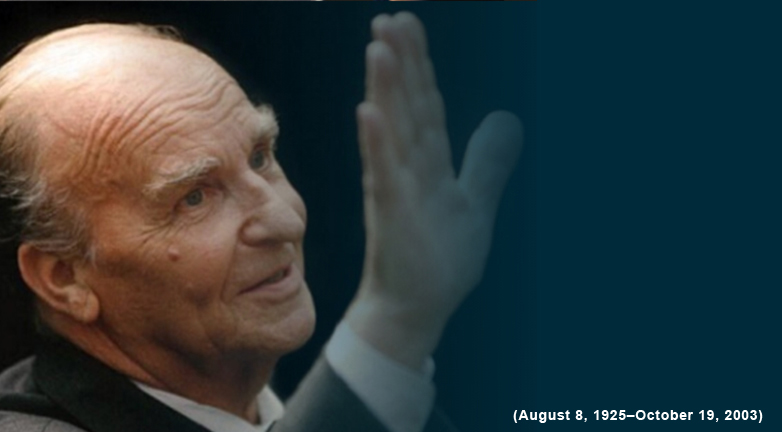
Alija Izetbegović passed away on October 19, 2003 due to heart ailment complicated by a sudden fall at home. He received honours at his bereavement and funeral took place after three days on October 22, 2003 from large number of Bosnian officials, dignitaries from 44 foreign countries, 105 members of the Grand National Assembly of Turkey and between 100,000 and 150,000 people, with his family receiving over 4,000 telegrams. Over 400 journalists attended the funeral and it was broadcast live on TV with 37 cameras.
REMEMBRANCE
The implementation of the Dayton Agreement of 1995 occupied the efforts of policy makers of Bosnia and Herzegovina and the international community for regional stabilization. Relations with neighbors, Croatia, Serbia and Montenegro, were described as fairly stable.
In 2010, the state received from NATO a Membership Action Plan. Full membership was expected in 2014 or 2015, depending on the progress of reforms, and NATO approved the Bosnian Membership Action Plan in December 2018. According to the Global Peace Index 2024, it is the 61st most peaceful country in the world.
It is considered that Alija Izetbegović left a deep mark as a thinker, politician and statesman. His ideas and interpretations shaped the political thought of Bosnia and Herzegovina before and after its international recognition. He wrote about Islam and contributed to its understanding which is appreciated across borders. He reflected upon and connected the verses of the Quran with social realties and empiricism. He stated—“Every rise of Islamic peoples, every period of dignity, begins with the affirmation of the Qur’an.”
Alija Izetbegović possessed the ability to re-examine social occurrences and phenomena in the context of his understanding of faith and time. He examined the relationship between Islam and modern civilization in his work Islam Between East and West, seeking essential values as foundations for a just society. He called upon the world to follow the Islamic commitment to morality, social justice and solidarity, and on its requirement to work with other religions for contribution to the promotion of civilization. He directly called on Muslims to re-examine their state of enlightenment, poverty, lack of unity and relevance to contemporary material and spiritual needs, of course in relation to other religions and worldviews. As a political leader, Alija Izetbegović was determined to face difficult situations with his personal strength and ideal principles of democracy, human rights and freedom of choice.
He advocated for Bosnia and Herzegovina as a multi-ethnic and multi-religious community with equal rights and opportunities for all citizens. In given circumstances, he was able to give strength to the religious, political and cultural identity of Muslims. His idea of learning from the past without glorifying it and building a better future from those experiences is highly valued.
Alija Izetbegović, a leader, teacher and activist, taught to believe, practice, struggle, love and live and let-live in the homeland. His life truly opens a wide space for intellectual efforts, philosophical reflections and pragmatic assessments, relevant to his homeland, the whole world and influential ideologies and factors that spread across oceans.
His one of the statements made after the signing of the Dayton Peace Agreement would be worthwhile to be quoted here:
“When you go through it all and endure it, when you rise again after a hundred stumbles, when you give up false hope and comfort and clench your teeth to openly face the truth, then you realize that the whole meaning of life is to fight evil.”
SELECTED WORKS
During his life, despite constant difficulties, Alija Izetbegović published extensively on various topics of interest. Some of his books are:
The Islamic Declaration: A Program for the Islamization of Muslims and the Muslim peoples Problems of Islamic Revival: A collection of articles Islam Between East and West: A study of the intersection of culture and religion in a globalized world My Escape to Freedom: prison notes and reflections Inescapable Questions: Autobiography
|
.jpg)

Click here



Registration is FREE, but all delegates should register online through the link given below:
https://forms.gle/AYmQ3WYJsXMKEhHg6
Link for attending the conference via Zoom will be shared in advance to the delegates who have successfully registered.
CONTACT US
Institute of Objective Studies
162, Joga Bai Main Road, Jamia Nagar
New Delhi –110 025 (India)
Tel. +91-11-26981187/ 26987467/26989253
Mob.: +91 9311226224, 9810131927
E-mail: info@iosworld.org
Website: www.iosworld.org |
|
|